
Loading Products...
Loading Products...
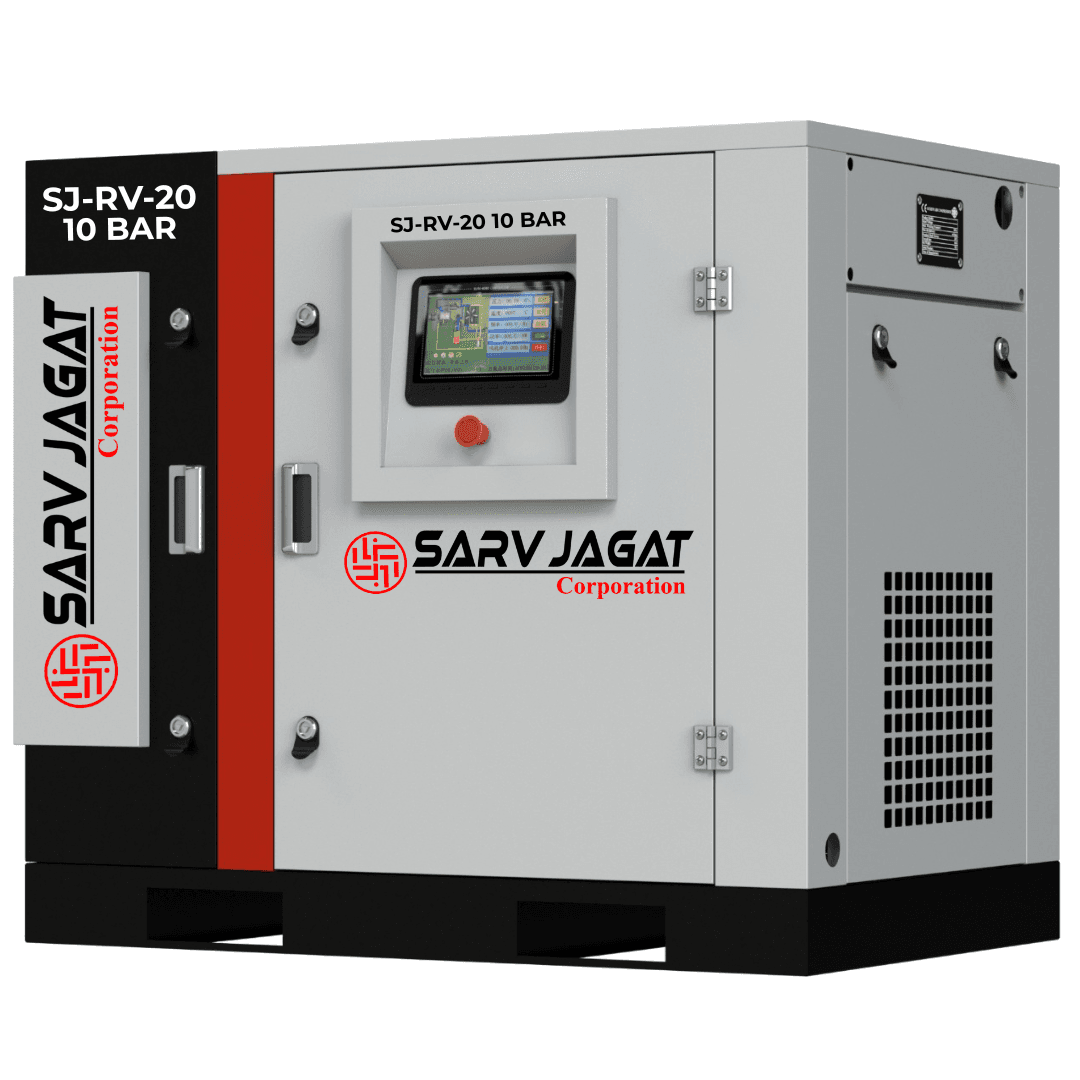
| Model Number | SJ RV 20 |
| Power Rating | 20 HP / 15 kW |
| Pressure Rating | 10 Bar / 145 PSI / 1 MPa |
| Air Flow | 71 CFM / 2.01 m³/min |
| Stage | Single Stage |
| Model Number | SJ RV 20 | Power Rating | 20 HP / 15 kW |
| Pressure Rating | 10 Bar / 145 PSI / 1 MPa | Air Flow | 71 CFM / 2.01 m³/min |
| Stage | Single Stage | Type | Variable Speed (VFD) |
| Technology | Oil Injected Rotary Screw | Drive | Direct Driven |
Discover other products that might interest you
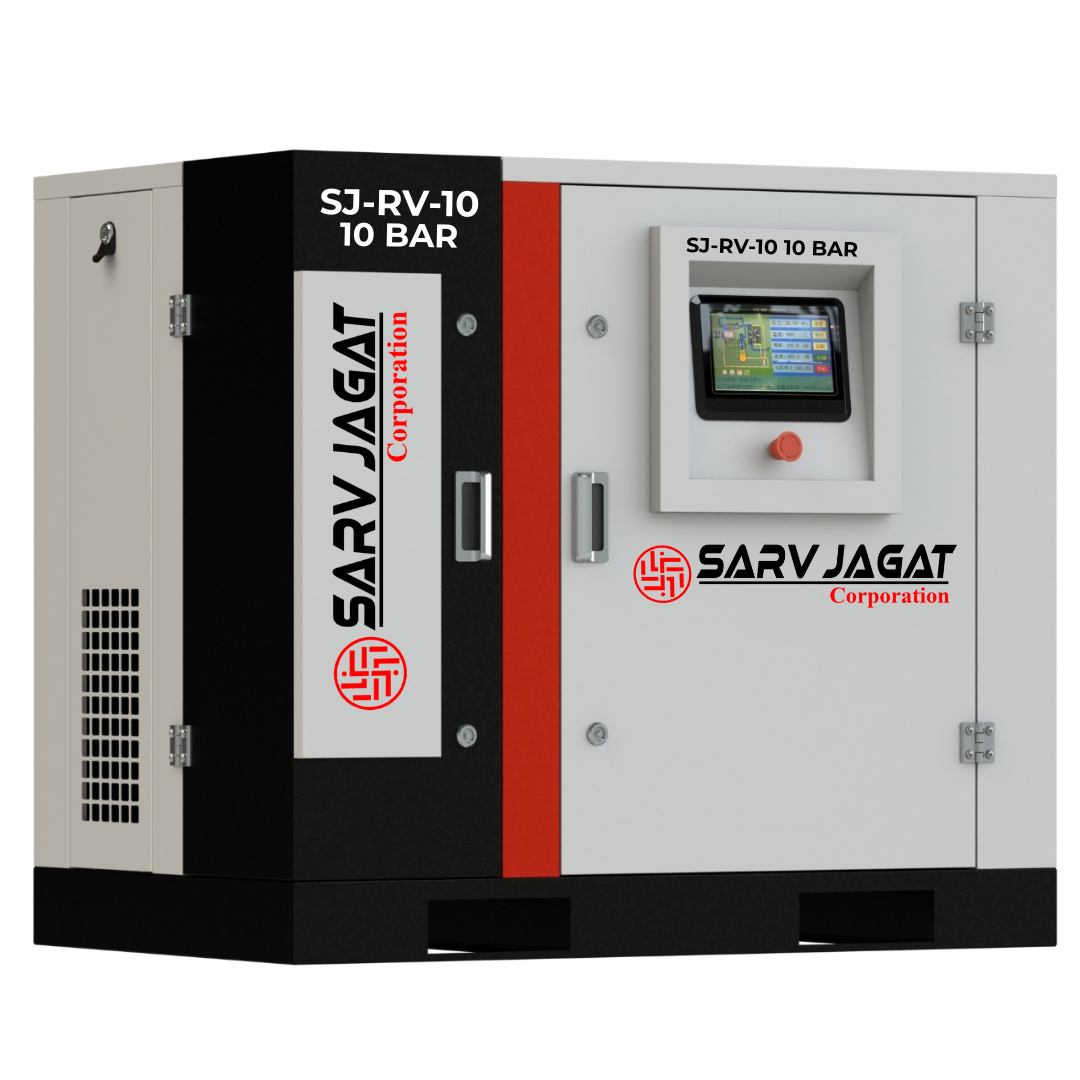
10 HP 10 Bar SJ VFD Variable Speed Screw Air Compressor – Model SJ RV10 The SJ RV10 is a 10 HP (7.5 kW) variable speed rotary screw air compressor designed for industrial applications requiring controlled compressed air delivery at a maximum operating pressure of 10 bar. With a specified airflow capacity of 34 CFM (0.96 m³/min) at 10 bar, the SJ RV10 combines rotary screw compression technology with an integrated Variable Frequency Drive (VFD) system. The VFD adjusts motor speed according to compressed air demand within its designed operating range. This variable-speed operating arrangement is particularly relevant for applications where compressed air consumption changes throughout the production cycle. Instead of relying exclusively on fixed-speed load/unload operation, the compressor can adjust its operating speed to respond to variations in system demand. The SJ RV10 is suitable for evaluating in applications such as CNC machining, automotive workshops, spray painting operations, pneumatic control systems and assembly lines with fluctuating compressed air requirements. Manufactured and supplied by Sarv Jagat Corporation in Ahmedabad, Gujarat, India, the SJ RV10 is part of the SJ variable-speed industrial screw air compressor range. Why Choose This Capacity? A 10 HP VFD screw air compressor is generally considered for smaller industrial facilities, individual production sections and machinery groups requiring a controlled compressed air supply. The SJ RV10 provides a specified airflow of 34 CFM (0.96 m³/min) at 10 bar, making it a capacity option for applications where both the required pressure and airflow are within the compressor's rated operating capability. Key capacity considerations include: • Variable Air Demand: Suitable for evaluating applications where compressed air consumption changes during different production cycles. • Controlled Pressure Supply: VFD technology adjusts motor speed to respond to changes in compressed air demand within its designed operating range. • Small Industrial Installations: Can be considered for workshops, individual manufacturing sections and smaller pneumatic production systems. • Precision Applications: Relevant for processes where maintaining a stable compressed air pressure is important. • Intermittent Machine Usage: Can be evaluated for machinery that operates with varying air consumption rather than maintaining a constant demand. • Capacity-Based Selection: The 34 CFM rated airflow should be compared with actual average and peak compressed air consumption before selecting the compressor. The SJ RV10 should be selected according to actual machinery requirements, operating pressure, peak airflow demand and the compressor's specified operating range. Important pressure-selection consideration: The SJ RV10 has different specified airflow capacities at different pressure ratings: • 8 Bar: 46 CFM (1.31 m³/min) • 10 Bar: 34 CFM (0.96 m³/min) • 13 Bar: 30 CFM (0.85 m³/min) Higher operating pressure generally requires more compressor energy. Therefore, 10 bar should be selected only when the connected machinery or process genuinely requires this pressure. If the application can operate reliably at a lower pressure, evaluating a lower-pressure configuration may help avoid unnecessary energy consumption. Advanced Rotary Screw Compression Technology The SJ RV10 uses single-stage rotary screw compression technology to generate compressed air for industrial applications. Rotary screw compressors use two intermeshing helical rotors to compress incoming air within the compression chamber. As the rotors rotate, air enters the compression element, becomes trapped between the rotor profiles and is progressively compressed before discharge. In a typical oil-injected rotary screw configuration, compressed air passes through an air-oil separation system and downstream cooling arrangement before entering the compressed air network. Key technology considerations include: • Rotary Screw Compression: Uses a rotating screw element to generate compressed air for industrial applications. • Single-Stage Compression: Uses a single compression stage as specified for the SJ RV10 model series. • VFD-Based Motor Control: Combines rotary screw compression with variable-speed motor operation. • Air-Oil Separation: In oil-injected configurations, the separation system reduces oil carryover from compressed air before downstream treatment. • Cooling and Temperature Management: Cooling systems help manage operating temperatures within the compressor. • Industrial System Integration: Can be integrated with a suitably selected air receiver, air dryer, moisture separator and filtration equipment. The final compressed air quality depends on the compressor configuration, downstream treatment equipment, installation conditions and maintenance practices. Applications requiring specific air purity levels must be designed around the relevant compressed air quality requirements. Variable Frequency Drive (VFD) Technology The SJ RV10 incorporates Variable Frequency Drive technology to adjust motor speed according to compressed air demand within its designed operating range. A VFD controls the electrical frequency supplied to the motor, allowing the motor speed to change instead of operating continuously at one fixed rotational speed. When compressed air consumption decreases, the VFD can reduce motor speed. When demand increases, the system can increase motor speed within its permitted operating range to respond to the changing requirement. Key VFD operating characteristics include: • Variable Motor Speed: Adjusts motor speed according to compressed air demand within the designed operating range. • Demand-Based Airflow: Compressor output changes as motor speed changes. • Pressure Regulation: Supports pressure control by adjusting compressor speed according to system requirements. • Partial-Load Operation: Can reduce unnecessary energy consumption when demand is lower than the compressor's maximum operating capacity. • Reduced Load/Unload Cycling: Variable-speed operation can reduce reliance on conventional fixed-speed load/unload cycling, depending on system demand and controller settings. • Controlled Motor Starting: VFD-based starting can provide a controlled acceleration profile, subject to drive configuration. • Application Flexibility: Relevant for production systems where compressed air consumption changes throughout the operating cycle. Potential energy benefits depend on the actual demand profile, pressure settings, operating hours, leakage, compressor operating range and system design. A VFD does not guarantee a fixed energy-saving percentage in every installation. For applications with consistently high and stable compressed air demand, a fixed-speed compressor may also be worth evaluating. The final selection should be based on a comparison of the expected operating profile and lifecycle electricity costs. Premium Industrial Components The performance and service life of a VFD rotary screw air compressor depend on the quality, compatibility and maintenance of its mechanical, electrical and cooling components. The SJ RV10 configuration can include the following functional systems, subject to the final supplied specification: • Rotary Screw Airend: The main compression assembly responsible for compressing incoming air. • Industrial Electric Motor: Supplies the mechanical power required to drive the compression system. Motor compatibility with the VFD, efficiency class, protection rating and insulation class should be confirmed from the approved technical specification. • Variable Frequency Drive: Controls motor speed by adjusting the electrical frequency supplied to the motor according to system demand. • Air Intake Filter: Filters incoming atmospheric air before it enters the compression system. • Oil Filter: Removes contaminants from the lubricating oil circuit to support proper lubrication. • Air-Oil Separator Element: Separates lubricating oil from compressed air in an oil-injected compressor configuration. • Lubricating Oil System: Supports lubrication, sealing and heat transfer within the compression system. • Oil Cooler: Helps regulate lubricating oil temperature during compressor operation. • Aftercooler: Reduces compressed air temperature downstream of the compression stage, subject to the supplied cooling arrangement. • Electrical Control Panel: Houses the electrical control and protection components required for compressor operation. • Compressor Controller: Provides operating information and control functions according to the installed controller configuration. • Acoustic Enclosure: Helps reduce operating noise and protects internal components, where included in the supplied model configuration. The exact airend, motor, VFD, controller, drive arrangement and component brands should be confirmed in the approved quotation and technical documentation. Component selection may vary according to the final compressor configuration. Reliable Industrial Performance The SJ RV10 is designed for industrial users evaluating a variable-speed compressed air solution for applications with changing airflow requirements. Its 10 HP motor rating and specified airflow of 34 CFM (0.96 m³/min) at 10 bar make it relevant for smaller industrial systems where pressure requirements remain important but compressed air consumption varies throughout the operating cycle. The VFD system allows the compressor to adjust motor speed according to demand within its designed operating range. This can help match compressed air production more closely with actual consumption and reduce unnecessary full-speed operation during periods of lower demand. However, reliable and economical operation depends on selecting the correct compressor capacity and operating range. A properly engineered installation should consider: • Actual compressed air consumption of connected machinery. • Average and peak airflow demand. • Required operating pressure at the point of use. • Variations in air consumption during production cycles. • VFD operating range and motor compatibility. • Pressure losses across pipelines, filters and air treatment equipment. • Air receiver capacity and pressure control strategy. • Ambient temperature and compressor room ventilation. • Required compressed air quality for each application. • Preventive maintenance requirements and replacement component availability. • Future production expansion and additional compressed air demand. For applications with frequent variations in compressed air consumption, the SJ RV10 can be evaluated as a variable-speed compressor option. The final selection should be based on measured or calculated demand rather than assuming that VFD technology automatically produces energy savings in every operating condition. Sarv Jagat Corporation provides industrial screw air compressor solutions along with associated compressed air equipment, spare parts and service support. The SJ RV10 can be evaluated as part of a compressed air installation designed around the actual pressure, airflow and operating requirements of the facility. Heavy Duty Cooling System The SJ RV10 is designed for industrial compressed air applications where effective temperature management is important for reliable compressor operation. During compression, air and lubricating oil temperatures increase. The cooling system helps manage these temperatures and maintain suitable operating conditions for the compressor components. The cooling arrangement may include: • Oil Cooling System: Helps regulate lubricating oil temperature during compressor operation. • Compressed Air Aftercooler: Reduces the temperature of compressed air before it enters the downstream air treatment system, where included. • Cooling Fan: Supports heat removal from the compressor enclosure. • Ventilation Arrangement: Helps circulate cooling air through the compressor. • Temperature Monitoring: Controller-based temperature monitoring and alarms, subject to the installed controller configuration. The compressor should be installed in a properly ventilated area with sufficient clearance for cooling airflow and routine maintenance. Hot cooling air should not be allowed to recirculate into the compressor intake or cooling system. The final cooling arrangement should be confirmed according to the supplied compressor configuration and installation conditions. Intelligent Electrical & Safety Features The SJ RV10 uses VFD-based motor control to adjust compressor speed according to compressed air demand within its designed operating range. The electrical control and protection arrangement is intended to support safe compressor operation. Exact electrical components and available monitoring functions depend on the supplied panel, VFD and controller configuration. Functional electrical and safety provisions may include: • Variable Frequency Drive: Adjusts motor speed by controlling the electrical frequency supplied to the motor. • Motor Protection: Electrical protection against specified motor operating faults. • Overload Protection: Helps protect the motor and drive system against excessive electrical loading. • Phase Protection: Phase-related protection, where provided in the electrical panel. • Temperature Monitoring: Monitoring of compressor operating temperatures through the controller, where supported. • Pressure Monitoring: Monitoring of system pressure for variable-speed operation. • Emergency Stop: Emergency stopping provision according to the supplied electrical arrangement. • Operating Status: Controller display for operating conditions and available alarm information. • Fault Indication: Displays or indicates detected operating faults according to controller functionality. The VFD, motor and electrical protection settings must be compatible with the actual motor specifications and compressor operating requirements. Electrical installation should follow the manufacturer's documentation and applicable electrical standards. Standard Features The following functional systems are associated with the SJ RV10 product configuration. Exact component brands, specifications and included accessories should be confirmed in the approved quotation. • 10 HP industrial variable-speed rotary screw compressor. • 7.5 kW motor rating. • 10 bar maximum operating pressure rating. • Rated airflow of 34 CFM (0.96 m³/min). • Single-stage rotary screw compression assembly. • Variable Frequency Drive (VFD) control system. • Variable motor speed according to compressed air demand within the designed operating range. • Air intake filtration system. • Lubricating oil circulation system for oil-injected configuration. • Oil filtration system. • Air-oil separation system for oil-injected configuration. • Cooling arrangement for operating temperature management. • Electrical control and protection panel. • Compressor controller according to supplied configuration. • Pressure monitoring and variable-speed control according to the supplied control arrangement. • Industrial compressor enclosure, where included in the supplied model configuration. Optional Features The following equipment can be considered when configuring a complete compressed air installation. These items should be treated as optional unless specifically included in the commercial quotation. • Refrigerated Air Dryer: Reduces moisture content in compressed air for general industrial applications. • Desiccant Air Dryer: Used where a lower pressure dew point is required. • Air Receiver Tank: Stores compressed air and helps manage short-term demand fluctuations. • Moisture Separator: Removes bulk liquid moisture from compressed air. • Pre-Filter: Removes particulate contamination and liquid aerosols according to its filtration rating. • After-Filter: Provides additional filtration for downstream compressed air applications. • Micro Filter: Used where finer aerosol filtration is required. • Activated Carbon Filter: Helps reduce oil vapour and odour, subject to the specified filter design. • Automatic Drain: Removes accumulated condensate from selected components. • Aluminium Compressed Air Piping: Provides a distribution network for treated compressed air. • Oil-Water Separator: Used for treating compressor condensate before disposal, subject to local environmental requirements. • Airflow Meter: Measures compressed air consumption within the distribution network. • Dew Point Monitor: Monitors moisture performance downstream of the air dryer. The dryer and filtration system should be selected according to the actual airflow of 34 CFM at the specified operating pressure. Selection must also account for inlet air temperature, ambient conditions, pressure drop, required pressure dew point and filtration grade. Technical Specifications Model Number: SJ RV10 Product Type: Industrial Rotary Screw Air Compressor Compressor Technology: Rotary Screw Operating Technology: Variable Speed Drive Technology: Variable Frequency Drive (VFD) / Variable Speed Drive (VSD) Compression Stage: Single Stage Motor Power: 10 HP Motor Power: 7.5 kW Maximum Operating Pressure: 10 Bar Pressure Equivalent: 145 PSI Pressure Equivalent: 1 MPa Rated Air Flow: 34 CFM Rated Air Flow: 0.96 m³/min Note: The above airflow and pressure values are the specified ratings for the SJ RV10 10 bar model. The 34 CFM rating is specific to the 10 bar configuration; it should not be confused with the model's 46 CFM rating at 8 bar or 30 CFM rating at 13 bar. Industrial Applications The SJ RV10 10 HP VFD variable-speed screw air compressor can be evaluated for industrial applications where compressed air demand fluctuates and controlled pressure delivery is required. Its specified airflow of 34 CFM (0.96 m³/min) at 10 bar makes it relevant for smaller industrial systems and individual machinery groups, provided the actual airflow and pressure requirements remain within the compressor's operating capability. Potential industrial applications include: 1. CNC Machines with Variable Cycle Loads Can be evaluated for CNC machining applications where pneumatic fixtures, tool-related systems and auxiliary equipment create changing compressed air demand during different machining cycles. 2. Automotive Workshops Suitable for evaluating compressed air requirements in workshops using pneumatic tools, maintenance equipment and other air-operated machinery with intermittent usage. 3. Spray Painting Booths Can be considered for selected spray painting and coating operations where compressed air demand varies with the production cycle. Required airflow, pressure stability and air-treatment specifications must be checked against the spray equipment requirements. 4. Pneumatic Control Systems Relevant for pneumatic control applications where air consumption changes according to machine operation, actuator activity and production requirements. 5. Assembly Lines with Batch Production Can be evaluated for assembly operations where compressed air consumption changes between production batches, machine cycles and operating stages. 6. Small Manufacturing Units Potentially suitable for smaller manufacturing operations using pneumatic tools, air-operated machinery and auxiliary production equipment within the compressor's rated capacity. 7. Industrial Automation Equipment Can support selected pneumatic actuators, cylinders, fixtures and automated handling systems where the required airflow and pressure are compatible with the compressor. 8. Packaging and Processing Equipment Can be considered for packaging machinery, filling equipment, sealing systems and other pneumatic applications with variable consumption, subject to individual machine specifications. 9. Engineering and Maintenance Workshops May be evaluated for pneumatic tools, maintenance equipment and general workshop compressed air requirements where the required pressure and airflow are within the rated capacity. 10. Intermittent Pneumatic Applications Can be considered for applications where compressed air consumption changes frequently rather than remaining at a constant level throughout the operating cycle. The compressor should not be selected solely because an application has variable demand. Actual average airflow, peak airflow, required pressure, operating hours and the VFD's designed operating range must be evaluated before final selection. Food and pharmaceutical installations require additional consideration. General utility compressed air should not automatically be treated as suitable for direct product contact or critical process applications. Such systems require a defined air-quality specification, appropriate filtration and drying, and validation against relevant process requirements. Compatible Accessories The SJ RV10 can be integrated with suitable compressed air treatment and distribution equipment to develop a complete industrial compressed air system. Compatible accessories include: • Air Receiver Tank – Provides compressed air storage and helps stabilise system pressure. • Refrigerated Air Dryer – Removes moisture for general-purpose industrial compressed air. • Desiccant Air Dryer – Provides lower dew-point compressed air where required. • Moisture Separator – Removes bulk liquid water from compressed air. • Pre-Filter – Removes larger particles and liquid contaminants. • After-Filter – Provides additional downstream filtration. • Micro Filter – Supports finer aerosol filtration requirements. • Activated Carbon Filter – Helps reduce oil vapour and odour. • Automatic Drain Valve – Automatically removes accumulated condensate. • Aluminium Air Piping – Distributes compressed air across the factory. • Oil-Water Separator – Treats oil-contaminated condensate before disposal. • Airflow Meter – Measures compressed air consumption and supports energy monitoring. • Dew Point Monitor – Monitors the moisture level of treated compressed air. Accessory selection should be based on the required pressure dew point, filtration grade, airflow, pressure drop, condensate load and application-specific air-quality requirements. Frequently Asked Questions Q1. What is the motor capacity of the SJ RV10 VFD screw air compressor? The SJ RV10 is a 10 HP variable-speed industrial screw air compressor with a motor power rating of 7.5 kW. Q2. What is the airflow capacity of the SJ RV10 at 10 bar? The specified airflow is 34 CFM, equivalent to 0.96 m³/min, at the 10 bar pressure rating. Q3. What is the difference between the SJ RV10 VFD and a fixed-speed screw compressor? The SJ RV10 uses a Variable Frequency Drive to adjust motor speed according to compressed air demand within its designed operating range. A fixed-speed compressor operates at a fixed motor speed during loaded operation and typically regulates output through load/unload control. Q4. How does VFD technology help reduce electricity consumption? A VFD can reduce motor speed when compressed air demand decreases, potentially reducing energy consumption during partial-load operation. Actual savings depend on the demand profile, operating hours, pressure settings, leakage and compressor operating range. A fixed energy-saving percentage cannot be guaranteed. Q5. Which industries can use the SJ RV10 10 bar VFD compressor? It can be evaluated for CNC machining applications, automotive workshops, spray painting operations, pneumatic control systems, assembly lines, small manufacturing units and selected industrial automation applications. Q6. Can the SJ RV10 maintain stable pressure when air demand changes? The VFD adjusts motor speed according to system demand and supports pressure regulation within its designed operating range. Actual pressure stability depends on controller settings, system design, demand fluctuations and compressor operating limits. Q7. Can the SJ RV10 operate with an air dryer and air receiver tank? Yes. It can be integrated with a suitably sized air receiver tank, refrigerated or desiccant air dryer, moisture separator and filtration equipment. Their capacities should be selected according to the compressor airflow, operating pressure and required compressed air quality. Q8. Is the SJ RV10 suitable for applications with continuous air demand? It can be evaluated for continuous industrial applications if the actual demand remains within the compressor's specified operating range and the installation conditions comply with manufacturer requirements. The application should be assessed for airflow, pressure, operating hours and duty requirements. Q9. What maintenance is required for the SJ RV10? Routine maintenance generally includes inspection and servicing of the air intake filter, oil filter, air-oil separator, compressor oil, cooling system, electrical connections and VFD-related components according to the manufacturer's maintenance schedule. Maintenance intervals should follow the approved service documentation. Q10. Is a 10 bar VFD compressor suitable for every pneumatic application? No. The required pressure depends on the connected machinery and production process. A 10 bar compressor should be selected only when the application genuinely requires this pressure. Unnecessarily high operating pressure can increase electricity consumption. Q11. Can the SJ RV10 be used for food and pharmaceutical applications? It may be considered for general utility compressed air, depending on the application. Direct product-contact and critical process applications require a defined compressed air quality standard, suitable downstream treatment and process validation. The compressor alone does not guarantee product-contact air quality. Why Choose Sarv Jagat? Sarv Jagat Corporation provides industrial compressed air solutions for manufacturing facilities, engineering industries and process applications. The SJ RV10 is part of the Sarv Jagat variable-speed rotary screw compressor range, developed for industrial users evaluating controlled compressed air delivery at 10 bar. Reasons to consider Sarv Jagat: • Variable-Speed Compressor Range: Solutions for applications with changing compressed air demand. • Industrial Compressor Range: Different motor capacities, pressure ratings and airflow configurations. • Technical Selection Support: Assistance in evaluating compressor capacity, pressure requirements and VFD suitability. • Complete Compressed Air Solutions: Compressor systems can be configured with air receivers, dryers, filters and piping accessories. • Spare Parts Support: Availability and selection of compatible compressor maintenance components, subject to model and configuration. • Service Support: Assistance with compressor maintenance and troubleshooting. • Industrial Applications: Equipment selection for manufacturing, engineering and other compressed air-dependent industries. • Ahmedabad-Based Business: Sarv Jagat Corporation operates from Ahmedabad, Gujarat, India, serving industrial customers. For SJ RV10 pricing, technical details, VFD configuration, installation requirements and a customised compressed air system quotation, contact Sarv Jagat Corporation. Sarv Jagat – Industrial Screw Air Compressors, Compressed Air Solutions, Spares & Service.
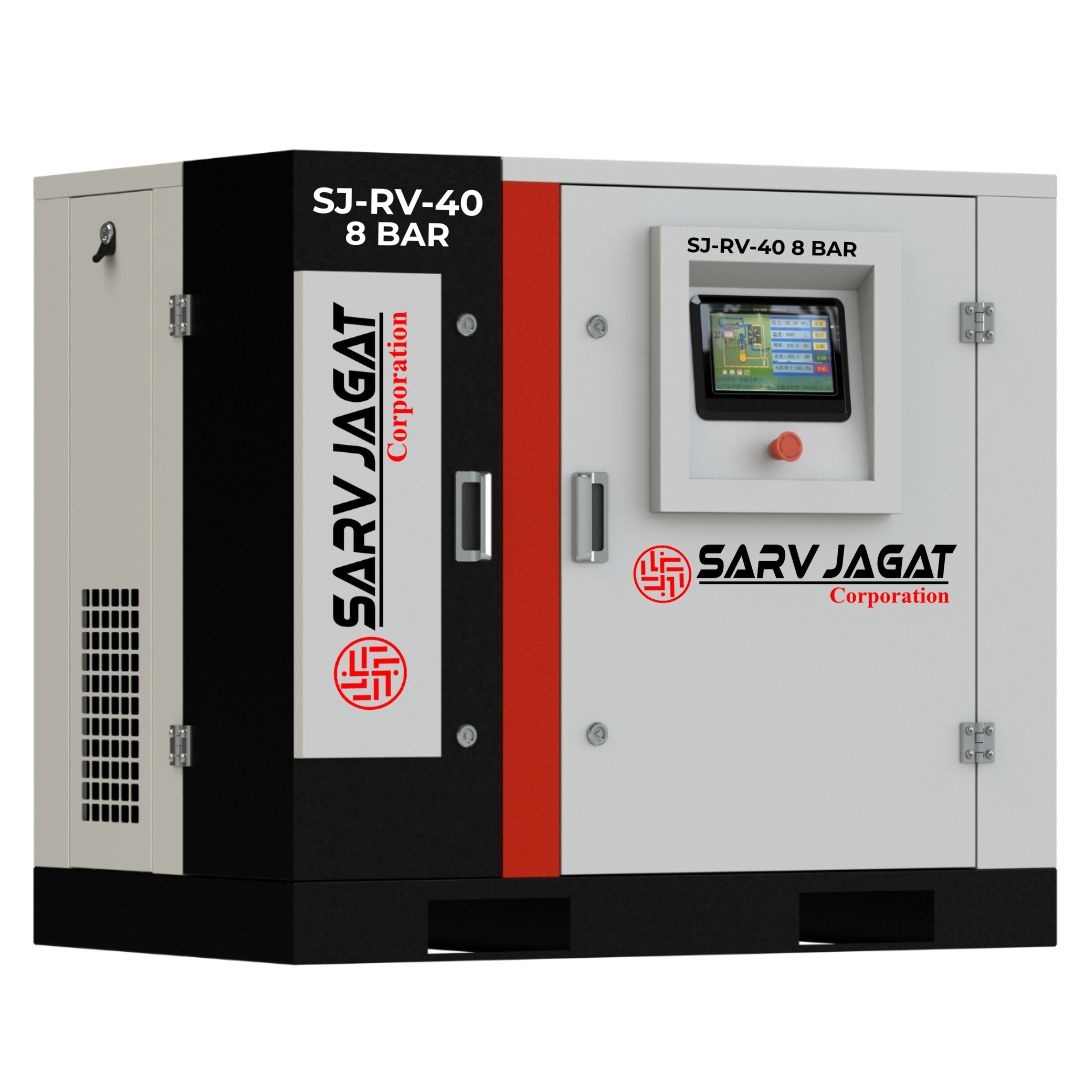
40 HP 8 Bar Variable Speed Rotary Screw Air Compressor The Sarv Jagat SJ RV40 is a 40 HP (30 kW) industrial variable speed rotary screw air compressor, engineered for manufacturing facilities and industrial operations requiring a higher-volume compressed air supply with variable demand control. Operating at a rated pressure of 8 Bar, the SJ RV40 delivers 184 CFM (5.21 m³/min) of rated airflow. Its Variable Frequency Drive (VFD) technology adjusts compressor motor speed according to changing compressed air demand, helping match air production more closely to actual consumption. The 40 HP capacity makes the SJ RV40 suitable for medium-to-large manufacturing facilities operating multiple pneumatic machines, automated production lines and air-operated industrial equipment. It is particularly relevant to installations where compressed air consumption varies throughout production shifts or between different processes. Combining rotary screw compression technology with variable speed motor control, the SJ RV40 provides an industrial compressed air solution for businesses seeking flexible air delivery, controlled operation and reliable production support. Why Choose This Capacity? The 40 HP compressor category is suitable for industrial facilities with substantial compressed air requirements, multiple connected machines and production processes that demand a higher airflow capacity. With a rated airflow of 184 CFM at 8 Bar, the SJ RV40 can support a range of pneumatic applications, provided that their combined operating demand remains within the compressor's available capacity. The 40 HP VFD configuration is particularly relevant to facilities where compressed air consumption changes according to production schedules, machine operating cycles and varying pneumatic loads. Unlike a conventional fixed-speed compressor that generally regulates air production through load/unload operation, the VFD system can adjust motor speed within its designed operating range to respond to changing air demand. Key capacity advantages: • 40 HP / 30 kW motor rating for demanding industrial compressed air requirements. • Rated airflow of 184 CFM (5.21 m³/min) at 8 Bar. • Variable speed operation for fluctuating compressed air consumption. • Suitable for multiple pneumatic machines and production equipment. • Helps reduce unnecessary unloaded operation under suitable operating conditions. • Greater operating flexibility for facilities with changing production loads. • Suitable for medium-to-large manufacturing and industrial installations. The correct compressor capacity should be selected using actual compressed air consumption, peak demand, required working pressure and future production requirements. Motor HP alone is not sufficient to determine whether a compressor can support a particular plant. Advanced Rotary Screw Compression Technology The SJ RV40 uses rotary screw compression technology, in which two precision-engineered helical rotors rotate inside a compression element to progressively compress incoming atmospheric air. As the rotors turn, air enters the compression chamber, becomes trapped between the rotor profiles and casing, and is compressed as the available volume decreases. Rotary screw compressors are widely used in industrial environments where a continuous and relatively stable compressed air supply is required. The compression system follows these principal operating stages: • Air Intake: Atmospheric air enters through the compressor's air intake and filtration arrangement. • Compression: The rotary screw airend compresses incoming air through the rotating screw elements. • Oil Injection and Separation: In an oil-injected configuration, lubricating oil supports sealing, lubrication and heat removal during compression. The downstream separation system separates oil from compressed air. • Cooling: The cooling arrangement manages heat generated during compression. • Air Delivery: Compressed air passes through the outlet connection into the connected compressed air distribution system. Variable Frequency Drive (VFD) Technology The SJ RV40 uses Variable Frequency Drive technology to regulate compressor motor speed according to compressed air demand. In a conventional fixed-speed compressor, the motor operates at a fixed speed, with air production generally controlled through load/unload operation. In a VFD compressor, motor speed can be adjusted within its permitted operating range to better match the required air output. When compressed air demand increases, the VFD can increase motor speed. When demand decreases, the drive can reduce motor speed, subject to the compressor's minimum and maximum operating limits. This operating method is relevant to industrial facilities where compressed air consumption changes throughout the working day due to production cycles, machine operation and varying pneumatic loads. Potential operating benefits include: • Better matching of compressor output with actual air consumption. • Reduced unnecessary unloaded operation under suitable demand conditions. • More controlled pressure regulation when correctly configured. • Greater operating flexibility for fluctuating compressed air requirements. • Potential reduction in electricity consumption compared with an appropriately comparable fixed-speed operating arrangement. Energy savings are not guaranteed at a fixed percentage. Actual performance depends on the compressed air demand profile, operating pressure, compressor control range, system leakage, installation conditions and annual operating hours. Premium Industrial Components The reliability and operating performance of an industrial screw compressor depend on its major mechanical, electrical and control components, together with correct system integration and preventive maintenance. The SJ RV40 is designed around an industrial compressor configuration incorporating the principal systems required for compressed air generation and variable speed operation. Rotary Screw Airend The screw airend is the main compression assembly. Its rotor profile, manufacturing precision, lubrication arrangement and operating conditions influence airflow performance, compression efficiency and service life. The airend must operate within its specified pressure, speed and temperature limits to maintain dependable performance. Industrial Electric Motor The electric motor drives the screw compression element and is selected according to the compressor's rated power and operating requirements. Important motor characteristics include rated power, insulation class, enclosure protection, cooling arrangement and efficiency rating. The final motor specification should be confirmed against the supplied configuration. Variable Frequency Drive The VFD controls motor speed according to compressed air demand. Correct drive selection, parameter configuration, electrical protection and cooling are essential for reliable variable speed operation. Air Filtration System The air intake filter helps prevent dust and airborne contaminants from entering the compression element. Regular filter inspection and replacement help maintain suitable intake conditions and reduce the risk of contamination. Oil Filtration and Separation System The oil filter removes contaminants from circulating compressor oil. The oil-air separator element separates lubricating oil from compressed air before the air reaches the compressor outlet. Cooling System The cooling arrangement manages heat generated during compression and supports operation within the intended temperature range. Cooling system cleanliness and adequate ventilation are particularly important in industrial environments with elevated ambient temperatures or airborne dust. Industrial Control System The compressor controller supports operating control and monitoring functions according to the supplied configuration. Controller functions, alarm features and communication options should be confirmed in the final technical quotation. Reliable Industrial Performance The Sarv Jagat SJ RV40 is developed for industrial facilities where compressed air is an essential utility for manufacturing equipment, pneumatic automation and production operations. Its 40 HP motor rating and specified airflow of 184 CFM at 8 Bar make it suitable for applications requiring a higher-volume compressed air supply with variable speed operation. The compressor can be integrated with an appropriately sized air receiver, refrigerated air dryer, moisture separator and compressed air filtration system to create a complete industrial compressed air installation. For dependable performance, the complete system should be engineered according to: • Actual compressed air consumption and simultaneous peak demand. • Required operating pressure at the point of use. • Pressure losses across dryers, filters and distribution piping. • Ambient temperature and compressor room ventilation. • Air quality requirements of connected production equipment. • Appropriate air receiver capacity and distribution pipe sizing. • Correct electrical supply and VFD installation. • Preventive maintenance and timely replacement of consumable elements. With correct selection, installation and maintenance, the SJ RV40 provides a practical variable speed compressed air solution for industrial users requiring 40 HP capacity and 8 Bar operating pressure. Heavy Duty Cooling System The Sarv Jagat SJ RV40 is designed with an industrial cooling arrangement to manage the heat generated during the rotary screw compression process. During compression, air temperature increases as its volume is reduced. The compressor cooling system helps maintain suitable operating temperatures for the compression element, lubricating oil and other heat-generating components. The cooling arrangement supports: • Heat removal from the lubricating oil and compression system. • Temperature management during industrial operation. • Stable compressor operation within the specified operating limits. • Reliable performance when the cooling system is maintained correctly. For dependable operation, maintain sufficient ventilation around the compressor, keep cooling surfaces clean and inspect the cooling arrangement at recommended service intervals. High ambient temperatures, restricted airflow and accumulated dust can negatively affect cooling performance. Intelligent Electrical & Safety Features The SJ RV40 uses Variable Frequency Drive (VFD) technology to regulate compressor motor speed according to compressed air demand. The VFD adjusts motor speed within the compressor's designed operating range. This allows the compressor to respond to changes in air consumption instead of relying exclusively on fixed-speed load/unload operation. Electrical and control functions are intended to support controlled compressor operation and equipment protection, subject to the final supplied controller and electrical configuration. Important operating considerations: • VFD-based motor speed regulation according to air demand. • Controlled compressor operation within specified speed limits. • Electrical protection according to the supplied drive and control-panel configuration. • Operating status and alarm indication through the supplied controller, where applicable. • Proper electrical earthing and correctly sized cables and protection devices. • VFD installation in accordance with the drive manufacturer's electrical and ventilation requirements. Standard Features The SJ RV40 is a 40 HP industrial variable speed rotary screw air compressor designed for 8 Bar compressed air applications. The following describes the principal functional systems of the compressor. Exact component brands, controller functions and supplied accessories should be confirmed against the approved technical quotation. • 40 HP / 30 kW motor rating. • Rated airflow: 184 CFM (5.21 m³/min) at 8 Bar. • Oil-injected rotary screw compression technology. • Variable Frequency Drive for variable speed operation. • Industrial electric motor and drive arrangement. • Air intake filtration system. • Lubricating oil filtration system. • Oil-air separation system. • Compressor cooling arrangement. • Industrial enclosure and control arrangement, as per supplied configuration. Optional Features The SJ RV40 can be configured with additional equipment according to the customer's application, compressed air quality requirements and installation conditions. • IE4 high-efficiency electric motor, subject to availability and compatibility. • Advanced compressor controller and monitoring options. • Remote monitoring and operating status communication, where supported. • Refrigerated air dryer for general industrial moisture removal. • Desiccant air dryer for applications requiring lower pressure dew points. • Air receiver tank for compressed air storage and demand management. • Moisture separator for bulk liquid water removal. • Pre-filter, after-filter and micro-filter for compressed air purification. • Activated carbon filter for oil vapour and odour reduction where required. • Automatic condensate drain for moisture removal. • Oil-water separator for condensate treatment. • Aluminium compressed air piping for industrial distribution systems. • Pressure monitoring and airflow measurement instruments. Optional equipment should be selected according to the required air quality class, pressure dew point, operating pressure, airflow and applicable industry requirements. Technical Specifications Product: Sarv Jagat Variable Speed Rotary Screw Air Compressor Model: SJ RV40 Compressor Type: Oil-Injected Rotary Screw Air Compressor Control Technology: Variable Frequency Drive (VFD) Motor Power: 40 HP Motor Power (kW): 30 kW Rated Working Pressure: 8 Bar Pressure Equivalent: Approximately 115 PSI Rated Air Delivery: 184 CFM Rated Air Delivery: 5.21 m³/min Compression Stage: Single Stage Drive Type: Direct Drive, subject to supplied configuration Cooling Type: Air Cooled Operating Control: Variable Speed Note: The airflow and pressure values above are the published rated specifications for the SJ RV40. Actual operating performance depends on installation conditions, ambient temperature, electrical supply, maintenance condition and the specified operating configuration. Industrial Applications The 40 HP SJ RV40 variable speed screw air compressor is suitable for industrial facilities requiring a higher-volume compressed air supply with changing consumption patterns. Its rated airflow of 184 CFM at 8 Bar makes it relevant to applications where multiple pneumatic machines or production processes operate with varying air demand. Typical applications include: 1. Automotive Manufacturing Pneumatic tools, assembly equipment, component production, workshop machinery and general plant air requirements. 2. Engineering and Fabrication Workshops Pneumatic equipment, machine operation, air-operated tools, material handling and fabrication processes. 3. CNC and Machine Manufacturing Pneumatic actuators, machine operations, cleaning and auxiliary equipment, subject to the air quality requirements of connected machinery. 4. Textile Industry Pneumatic machinery, automation systems, fabric processing equipment and other compressed air-operated production systems. 5. Plastic Manufacturing Pneumatic automation, material handling, machine auxiliaries and supporting production equipment. 6. Packaging Industry Pneumatic cylinders, packaging machines, product handling systems and automated production lines. 7. Pharmaceutical Manufacturing General utility compressed air and supporting plant equipment. Direct product-contact or critical process applications require appropriately specified air treatment and validation. 8. Food and Beverage Industry General utility compressed air for production support and packaging equipment. Direct-contact applications require suitable air treatment and compressed air quality controls. 9. Printing and Paper Industry Pneumatic actuators, printing machinery, material handling and automated production equipment. 10. General Manufacturing Industrial pneumatic systems, air-operated machinery and plant utility applications. Final compressor selection should be based on total connected demand, simultaneous consumption, peak airflow, pressure losses and the air quality required at the point of use. Compatible Accessories For a complete compressed air installation, the SJ RV40 can be integrated with suitable air treatment, storage and distribution equipment. Recommended accessory categories include: • Air Receiver Tank – Stores compressed air and helps manage short-duration variations in demand. • Refrigerated Air Dryer – Removes moisture from compressed air for general industrial applications. • Desiccant Air Dryer – Provides lower pressure dew points for moisture-sensitive processes. • Moisture Separator – Removes bulk liquid water from the compressed air stream. • Pre-Filter – Removes larger particulate and liquid contaminants. • After-Filter – Provides additional particulate and oil aerosol filtration. • Micro-Filter – Provides fine filtration for applications requiring cleaner compressed air. • Activated Carbon Filter – Reduces residual oil vapour and odour where required. • Automatic Drain Valve – Automatically discharges accumulated condensate. • Oil-Water Separator – Helps separate oil from compressor condensate before disposal, subject to applicable regulations. • Aluminium Air Piping – Provides a suitable compressed air distribution network. • Airflow Meter – Measures compressed air consumption for system monitoring. • Pressure Monitoring System – Helps monitor operating pressure and identify system pressure variations. • Dew Point Monitor – Measures moisture performance downstream of the air dryer. Accessory capacity and filtration grades must be selected according to the compressor's actual airflow, operating pressure and application requirements. Frequently Asked Questions Q1. What is the airflow capacity of the SJ RV40 compressor? The SJ RV40 has a rated airflow of 184 CFM (5.21 m³/min) at 8 Bar, according to the published technical specification. Q2. What is the difference between SJ RV40 and SJ RF40? Both models have a 40 HP motor rating and a specified airflow of 184 CFM at 8 Bar. The key difference is their control technology. SJ RV40 uses Variable Frequency Drive (VFD) technology to adjust motor speed according to air demand, while SJ RF40 is the fixed-speed version. Q3. How does VFD technology help reduce electricity consumption? A VFD adjusts motor speed according to compressed air demand within the compressor's designed operating range. When demand decreases, the compressor can reduce its speed instead of operating continuously at full speed. This can reduce energy consumption under suitable operating conditions. Actual savings depend on the air-demand profile, operating pressure, system leakage, operating hours and compressor configuration. Q4. Which air dryer is suitable for the SJ RV40? A refrigerated air dryer is commonly used for general industrial compressed air applications. A desiccant air dryer may be required when the process needs a lower pressure dew point. Dryer selection should be based on airflow, inlet temperature, operating pressure, ambient conditions and required air quality. Q5. Can the SJ RV40 operate continuously in an industrial facility? The SJ RV40 is designed for industrial compressed air applications. Continuous operation depends on correct compressor sizing, ventilation, cooling conditions, electrical supply, operating limits and preventive maintenance. The installation should follow the manufacturer's operating and service recommendations. Why Choose Sarv Jagat? Sarv Jagat Corporation provides industrial compressed air solutions covering screw air compressors, reciprocating air compressors, air dryers, air receiver tanks, filtration systems, spare parts and compressed air services. The SJ RV40 is part of the Sarv Jagat variable speed screw compressor range, developed for industrial users requiring a 40 HP compressor with VFD-based operation and a rated airflow of 184 CFM at 8 Bar. Reasons to consider Sarv Jagat: • Industrial screw compressor solutions for different power and pressure requirements. • Fixed-speed and variable-speed compressor options. • Compressed air system equipment, including dryers, tanks and filters. • Spare parts and compressor service support. • Application-based compressor and air treatment selection. • Solutions for manufacturing, engineering, automotive, textile, packaging and other industrial sectors. For technical selection, system configuration, pricing or a quotation for the SJ RV40 40 HP VFD Screw Air Compressor, contact Sarv Jagat Corporation. Sarv Jagat – Industrial Air Compressors, Spares & Service.
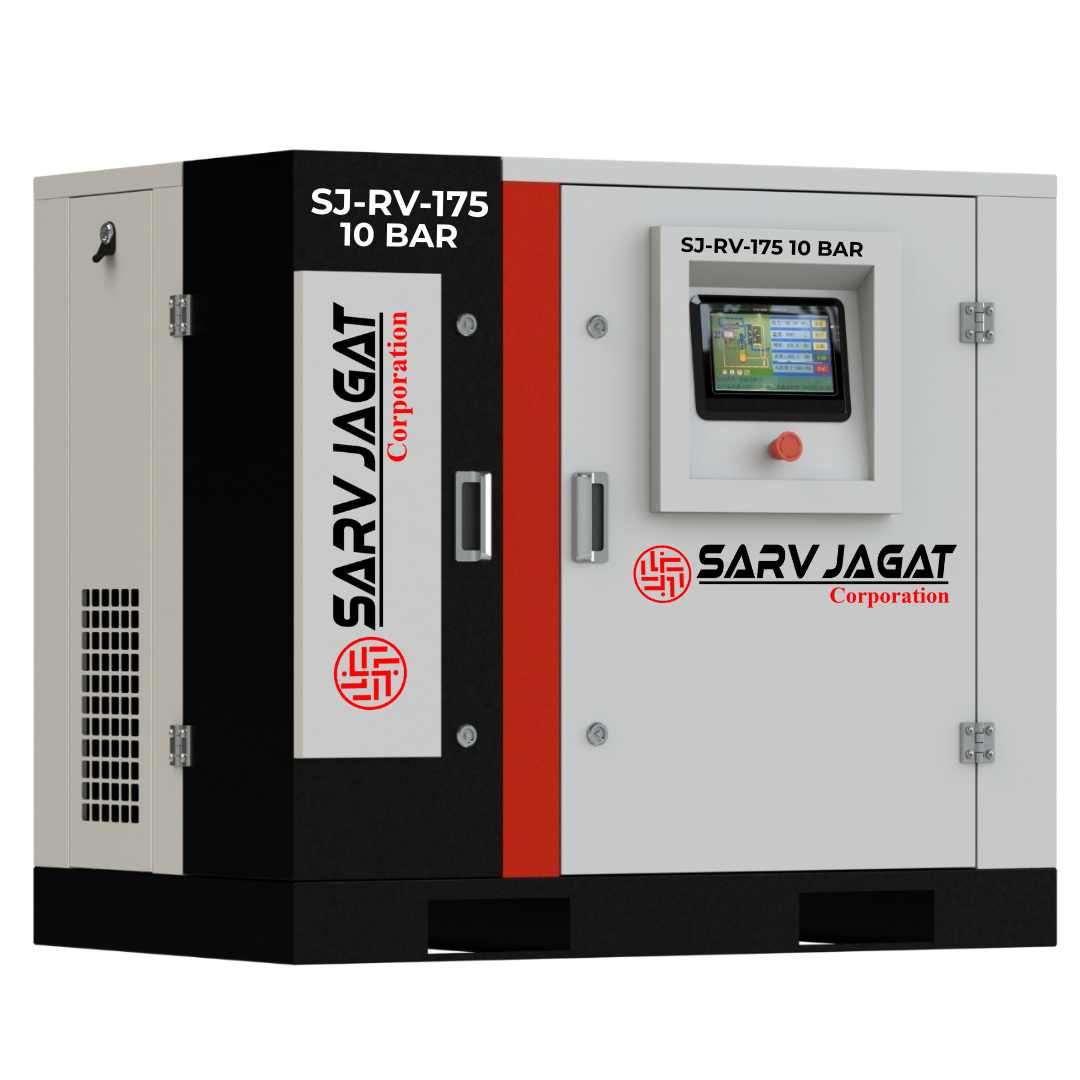
175 HP 10 Bar SJ VFD Variable Speed Screw Air Compressor – SJ RV175 The SJ RV175 is a 175 HP (132 kW) industrial variable-speed rotary screw air compressor designed for large manufacturing facilities and industrial operations requiring high compressed air capacity at 10 bar pressure. With a specified airflow of 706 CFM (19.99 m³/min) at 10 bar, the SJ RV175 is intended for demanding compressed air installations involving multiple production lines, large CNC machining clusters, automotive manufacturing, industrial automation and centralized factory air networks. The compressor combines single-stage rotary screw compression technology with Variable Frequency Drive (VFD) operation. Its VFD arrangement adjusts motor speed according to compressed air demand within the designed operating range, allowing compressor output to respond to changes in plant consumption. In large industrial facilities, compressed air demand can fluctuate as machines start and stop, production lines change operating rates and different departments run simultaneously. A variable-speed compressor can help match air generation with these changing requirements. The SJ RV175 is designed for applications where the required operating pressure is 10 bar and the calculated airflow requirement is compatible with its rated capacity. KEY PRODUCT SPECIFICATIONS • Model: SJ RV175 • Compressor Type: Industrial Rotary Screw Air Compressor • Motor Power: 175 HP / 132 kW • Operating Pressure: 10 Bar • Pressure Equivalent: 145 PSI / 1 MPa • Rated Air Flow: 706 CFM • Metric Air Flow: 19.99 m³/min • Compression Stage: Single Stage • Operating Technology: Variable Speed • Drive Technology: Variable Frequency Drive (VFD) WHY CHOOSE THIS CAPACITY? A 175 HP industrial screw compressor is considered for installations with substantial compressed air consumption across multiple machines, production departments or process systems. The SJ RV175 provides a specified airflow of 706 CFM (19.99 m³/min) at 10 bar. Its capacity should be assessed against the actual compressed air demand of the plant, including simultaneous consumption, peak demand and future expansion requirements. 1. HIGH-CAPACITY COMPRESSED AIR GENERATION With a specified airflow of 706 CFM at 10 bar, the SJ RV175 can be evaluated for industrial facilities where the combined compressed air requirement is beyond the capacity of smaller compressor configurations. Potential applications include: • Large CNC and VMC machining clusters. • Automotive manufacturing and assembly plants. • High-capacity packaging and bottling facilities. • Industrial automation and robotic production systems. • Large engineering and fabrication facilities. • Chemical and process manufacturing plants. • Centralized compressed air installations. The actual suitability depends on the required airflow, minimum operating pressure, air quality and operating conditions. 2. VARIABLE AIR DEMAND MANAGEMENT Compressed air consumption in large manufacturing facilities is not always constant. For example: • Several production lines may operate simultaneously during peak production. • Individual departments may stop or reduce production at different times. • Pneumatic actuators and machinery may consume air intermittently. • Automated production systems may have different consumption patterns. • Shift changes can create variations in total compressed air demand. The VFD arrangement allows motor speed to be adjusted according to the configured control demand within the compressor's designed operating range. This makes variable-speed technology relevant to installations where compressed air consumption changes throughout the production cycle. 3. CENTRALIZED COMPRESSED AIR SYSTEMS Large manufacturing facilities often use centralized compressor rooms to supply several production departments through a common compressed air distribution network. The SJ RV175 can be evaluated as a primary compressed air source where the calculated plant demand is compatible with its rated capacity of 706 CFM at 10 bar. Centralized system design should consider: • Total connected equipment demand. • Simultaneous operating airflow. • Average and peak compressed air consumption. • Required pressure at the point of use. • Air receiver capacity. • Pipeline diameter and pressure losses. • Air leakage across the distribution network. • Required compressed air quality. • Future production expansion. A compressor should not be selected only by adding the nominal air consumption of every connected machine. Actual simultaneous demand and operating patterns should be assessed. 4. 10 BAR INDUSTRIAL PRESSURE REQUIREMENT The SJ RV175 is specified for a 10 bar operating pressure configuration. This pressure should be selected when the connected machinery and production processes genuinely require it. Before choosing a 10 bar compressor, evaluate: • Minimum pressure required by production machinery. • Pressure losses across filters and dryers. • Pipeline pressure drop between the compressor room and points of use. • Required pressure at the most distant machine. • Pressure fluctuations during peak consumption. • Possibility of reducing system pressure through improved distribution design. Operating at a higher pressure than necessary can increase electricity consumption. The system should therefore be designed around the minimum pressure that reliably satisfies production requirements. ADVANCED ROTARY SCREW COMPRESSION TECHNOLOGY The SJ RV175 uses single-stage rotary screw compression technology for industrial compressed air generation. A rotary screw compressor uses two intermeshing helical rotors inside a compression element. Air enters through the intake side, becomes trapped between the rotor profiles and casing, and is compressed as it moves towards the discharge side. This continuous compression process is suitable for industrial installations requiring substantial compressed air capacity. PRINCIPAL COMPRESSION PROCESS 1. AIR INTAKE Ambient air enters through the compressor's air intake arrangement. An intake filtration system helps reduce the entry of dust and airborne particles into the compression system. The intake filter requires regular inspection and maintenance according to the operating environment. Dust accumulation can restrict airflow and increase pressure drop across the filter. 2. ROTARY SCREW COMPRESSION The compression element uses two rotating screw rotors to reduce the volume of trapped air and increase its pressure. The compressor's single-stage compression arrangement is designed to deliver compressed air according to the selected operating pressure configuration. 3. LUBRICATION AND INTERNAL COOLING For an oil-injected rotary screw configuration, lubricating oil performs several functions within the compression process. These functions generally include: • Lubrication of moving components. • Sealing between rotor clearances. • Absorption and removal of heat generated during compression. • Supporting the operating conditions of the compression element. The exact oil circuit and component arrangement depend on the supplied compressor configuration. 4. AIR-OIL SEPARATION In an oil-injected screw compressor, compressed air leaving the compression element contains oil that must be separated before the air is delivered to the downstream system. An air-oil separation arrangement reduces oil carryover in the compressed air stream. The separator element requires inspection and replacement according to the manufacturer's maintenance schedule and actual operating conditions. 5. COMPRESSED AIR DISCHARGE After the separation and cooling stages included in the supplied configuration, compressed air is discharged towards the downstream compressed air installation. Depending on the system design, downstream equipment may include: • Air receiver tank. • Moisture separator. • Refrigerated or desiccant air dryer. • Compressed air filters. • Distribution piping. The required treatment arrangement depends on the application and specified compressed air quality. VARIABLE FREQUENCY DRIVE (VFD) TECHNOLOGY The SJ RV175 uses Variable Frequency Drive technology to regulate motor speed according to compressed air demand within its designed operating range. This is relevant for large industrial installations where compressed air consumption can change significantly during production. Unlike a conventional fixed-speed arrangement, where the motor operates at a substantially fixed speed during loaded operation, a VFD compressor can vary motor speed by adjusting the electrical frequency supplied to the motor. HOW VFD CONTROL WORKS 1. PRESSURE MONITORING The compressor control arrangement monitors system pressure through its configured pressure feedback system. 2. DEMAND RESPONSE When compressed air consumption increases, system pressure can decrease. The control system can increase motor speed within the permitted operating range to respond to the increased demand. 3. SPEED ADJUSTMENT When compressed air consumption decreases, the control system can reduce motor speed within the designed operating limits. 4. AIRFLOW REGULATION Changing motor speed changes compressor output. This allows air generation to respond to variations in system demand. 5. PRESSURE CONTROL The VFD and controller work together to regulate compressor operation according to configured pressure settings and control parameters. OPERATIONAL RELEVANCE IN LARGE INDUSTRIAL PLANTS Consider a large manufacturing facility operating multiple production departments. During peak production, CNC machines, automated assembly systems, pneumatic fixtures and packaging lines may operate simultaneously. At other times, some departments may reduce production or stop individual machines. Consequently, total compressed air consumption changes throughout the day. A variable-speed compressor can adjust motor speed to respond to these changes within its designed operating range. POTENTIAL OPERATIONAL BENEFITS • Variable Output: Compressor airflow can be adjusted according to demand within the designed operating range. • Demand Matching: Helps match compressed air generation with changing plant consumption. • Pressure Regulation: Supports pressure regulation through the configured VFD and controller arrangement. • Reduced Load-Unload Cycling: Can reduce reliance on conventional load-unload cycling under suitable operating conditions. • Partial-Load Operation: Can reduce unnecessary full-speed operation when plant demand is below the compressor's available capacity. • Centralized System Integration: Can be evaluated for compressed air networks with changing demand. VFD ENERGY CONSUMPTION CONSIDERATIONS A VFD does not guarantee a fixed percentage of electricity savings. Actual energy performance depends on: • Daily compressed air demand profile. • Average operating load. • Required system pressure. • Compressor operating range. • Air leakage throughout the distribution network. • Number of operating compressors. • Control strategy. • Operating hours. • Maintenance condition. The greatest potential for energy reduction generally exists where compressed air demand varies sufficiently and the compressor can operate efficiently across the required range. If the plant operates continuously near full compressor capacity, the energy advantage over a correctly selected fixed-speed compressor may be limited. For this reason, a demand assessment and comparison of specific power consumption under actual operating conditions are recommended before making an energy-saving estimate. PRESSURE-WISE AIRFLOW CONFIGURATIONS The official SJ specification sheet lists different airflow capacities for the SJ RV175 at different pressure configurations. • 8 Bar: 883 CFM / 25.01 m³/min • 10 Bar: 706 CFM / 19.99 m³/min • 13 Bar: 636 CFM / 18.01 m³/min For this product page, the applicable configuration is: SJ RV175 – 175 HP – 10 Bar – 706 CFM – 19.99 m³/min. The airflow figures for 8 bar and 13 bar must not be used as the rated airflow for the 10 bar configuration. PREMIUM INDUSTRIAL COMPONENTS A 175 HP industrial screw compressor requires appropriately selected mechanical, electrical and cooling components to support its intended operating conditions. The following are important functional systems to consider in the SJ RV175 configuration. Exact component brands, specifications and supplied arrangements should be confirmed in the approved technical quotation. 1. ROTARY SCREW AIR END The air end is the principal compression component of a rotary screw compressor. Its rotor geometry, clearances, lubrication requirements and operating speed influence compressor performance. For the SJ RV175, the air end must be selected to support the specified operating pressure and airflow configuration. 2. INDUSTRIAL ELECTRIC MOTOR The motor supplies the mechanical power required to drive the compression element. The SJ RV175 has a specified motor power rating of 175 HP (132 kW). Motor selection should account for: • Rated power. • Operating speed. • Electrical supply. • Insulation and enclosure requirements. • VFD compatibility. • Cooling requirements. • Permitted operating frequency range. The exact motor make, efficiency class, protection rating and insulation details should be confirmed from the supplied motor documentation. 3. VARIABLE FREQUENCY DRIVE The VFD regulates the electrical frequency supplied to the motor and controls motor speed according to the configured compressor control strategy. Correct VFD selection is important for a 175 HP motor. The drive must be suitable for the motor rating, operating conditions, electrical supply and compressor operating range. 4. AIR INTAKE FILTER The intake filter reduces the entry of dust and airborne particles into the compressor. Its condition affects intake airflow and contributes to protection of the compression system. Inspection frequency should be adjusted according to the dust concentration and operating environment. 5. OIL FILTER The oil filter removes contaminants from the lubricating oil circuit. Maintaining suitable oil filtration helps protect the lubrication system and compression element. Replacement should follow the manufacturer's maintenance schedule and actual operating conditions. 6. AIR-OIL SEPARATOR ELEMENT The separator element reduces oil carryover from compressed air in an oil-injected screw compressor. Its condition influences separation performance and pressure drop. The element should be inspected and replaced according to the manufacturer's specified service interval and operating conditions. 7. COOLING SYSTEM The compressor cooling arrangement helps control operating temperatures. Depending on the supplied configuration, the cooling system may include an oil cooler, compressed air aftercooler and cooling fan. Adequate ventilation and regular cleaning are important for maintaining suitable operating conditions. 8. ELECTRICAL CONTROL PANEL The electrical control system coordinates compressor operation and available protection functions. It may include the VFD, controller, electrical protection devices and associated control components according to the supplied configuration. Correct installation, earthing, protection coordination and parameter configuration are essential for reliable operation. RELIABLE INDUSTRIAL PERFORMANCE The SJ RV175 is intended for industrial applications where a high-capacity compressed air supply is required at a specified pressure of 10 bar. Its 175 HP motor rating, single-stage rotary screw compression arrangement and VFD operating technology provide a configuration for evaluating high-capacity compressed air generation in large manufacturing and process environments. For reliable system operation, compressor selection should be supported by an assessment of actual airflow demand, pressure requirements, air treatment, electrical infrastructure and installation conditions. IMPORTANT INSTALLATION CONSIDERATIONS Before installing the SJ RV175, evaluate: • Electrical supply capacity for a 175 HP / 132 kW motor and its VFD arrangement. • Suitable cable sizing, protection and earthing. • Compressor room ventilation and heat removal. • Required service and maintenance clearance. • Foundation and floor-loading suitability. • Air receiver and downstream treatment requirements. • Compressed air pipeline sizing. • Pressure drop across the distribution network. • Ambient temperature and site conditions. • Condensate collection and disposal arrangements. The compressor should be installed and commissioned according to the approved manufacturer's instructions and applicable electrical and safety requirements. APPLICATION-BASED CAPACITY SELECTION The SJ RV175 should be selected when the calculated compressed air requirement is compatible with its specified capacity of 706 CFM at 10 bar. For plants with variable demand, the VFD arrangement can be evaluated against the actual demand profile. For plants with consistently high demand, selection should also consider the compressor's operating range, full-load requirements and the possible use of multiple compressors. A correctly engineered compressed air system should provide the required pressure and airflow at the point of use without unnecessary pressure losses or excessive operating pressure. HEAVY DUTY COOLING SYSTEM The SJ RV175 is a 175 HP (132 kW) industrial screw air compressor intended for high-capacity compressed air applications. Effective heat management is important for maintaining suitable operating conditions across the compression, lubrication and electrical systems. The cooling arrangement helps remove heat generated during compressor operation. Depending on the supplied configuration, the system may include the following functional components: • Oil Cooler: Helps regulate lubricating oil temperature in an oil-injected compressor arrangement. • Compressed Air Aftercooler: Reduces compressed air temperature before downstream treatment, where included. • Cooling Fan: Supports heat removal from the compressor package. • Ventilation System: Helps maintain airflow through the compressor enclosure. • Temperature Monitoring: Supports monitoring of selected operating temperatures, subject to controller configuration. COOLING AND INSTALLATION REQUIREMENTS For a 175 HP compressor, compressor-room ventilation and heat removal should be considered during installation planning. Important considerations include: • Adequate ventilation in the compressor room. • Sufficient clearance around cooling air intake and discharge openings. • Prevention of hot cooling-air recirculation. • Regular cleaning of cooling surfaces and ventilation openings. • Suitable ambient temperature for the compressor package. • Provision for removal or ducting of hot cooling air where necessary. • Accessibility for inspection and scheduled maintenance. Poor ventilation, blocked cooling surfaces or excessive ambient temperature can adversely affect compressor operating conditions. The final cooling arrangement and permissible operating limits should be confirmed from the supplied technical documentation. INTELLIGENT ELECTRICAL & SAFETY FEATURES The SJ RV175 uses Variable Frequency Drive technology to regulate motor speed according to compressed air demand within its designed operating range. The electrical control system coordinates motor operation, variable-speed regulation and available monitoring and protection functions. Depending on the supplied VFD, controller and electrical panel configuration, functional provisions may include: • Variable Frequency Drive: Adjusts the electrical frequency supplied to the motor to regulate operating speed. • Motor Protection: Provides protection against specified motor operating faults. • Overload Protection: Helps protect the motor and electrical system against excessive loading. • Phase Protection: Provides phase-related electrical protection where included in the panel. • Temperature Monitoring: Monitors selected compressor temperatures where supported by the controller. • Pressure Monitoring: Provides pressure feedback for compressor control according to the supplied arrangement. • Emergency Stop: Provides an emergency stopping function according to the electrical configuration. • Operating Status Display: Displays available operating information and system conditions. • Fault Indication: Indicates detected faults according to controller functionality. ELECTRICAL INSTALLATION CONSIDERATIONS The 175 HP / 132 kW motor and VFD arrangement require appropriate electrical infrastructure. Before commissioning, verify: • Electrical supply compatibility. • VFD rating and motor compatibility. • Cable sizing and current-carrying capacity. • Correct earthing and electrical protection. • Suitable ventilation for the electrical panel and VFD. • Correct drive parameter configuration. • Protection coordination with the plant electrical system. Electrical installation and commissioning should follow the manufacturer's documentation and applicable electrical standards. STANDARD FEATURES The following describes the principal functional systems associated with the SJ RV175 product configuration. Exact component brands, ratings and included equipment should be confirmed in the approved quotation. • 175 HP industrial variable-speed rotary screw air compressor. • 132 kW motor power rating. • 10 bar maximum operating pressure rating. • Rated airflow of 706 CFM (19.99 m³/min) at 10 bar. • Single-stage rotary screw compression arrangement. • Variable Frequency Drive (VFD) operating technology. • Variable motor speed within the designed operating range. • Air intake filtration system. • Lubrication system for oil-injected compressor configuration. • Oil filtration system. • Air-oil separation system for oil-injected configuration. • Compressor cooling arrangement. • Electrical control and protection system. • Compressor controller according to supplied configuration. • Pressure monitoring and variable-speed regulation according to the supplied control arrangement. • Industrial enclosure, where included in the supplied configuration. OPTIONAL FEATURES The SJ RV175 can be integrated with additional compressed air storage, treatment and distribution equipment according to the requirements of the industrial installation. The following equipment should be considered optional unless specifically included in the approved quotation. • Refrigerated Air Dryer: Reduces moisture content for general-purpose industrial compressed air. • Desiccant Air Dryer: Provides lower pressure dew point air where required by the process. • Air Receiver Tank: Stores compressed air and helps manage short-duration demand fluctuations. • Moisture Separator: Removes bulk liquid moisture from compressed air. • Pre-Filter: Removes particulate contamination and liquid aerosols according to its filtration rating. • After-Filter: Provides additional downstream filtration. • Micro Filter: Supports finer aerosol filtration requirements. • Activated Carbon Filter: Helps reduce oil vapour and odour, subject to filter design and operating conditions. • Automatic Drain Valve: Removes accumulated condensate from selected system components. • Aluminium Compressed Air Piping: Distributes compressed air across the factory. • Oil-Water Separator: Treats oil-contaminated condensate before disposal, subject to applicable environmental requirements. • Airflow Meter: Measures compressed air consumption across the distribution network. • Dew Point Monitor: Monitors moisture performance downstream of the air dryer. AIR TREATMENT SELECTION FOR 706 CFM For the SJ RV175 10 bar configuration, downstream equipment should be selected for the actual operating airflow of 706 CFM at 10 bar. Important selection parameters include: • Rated airflow capacity of the dryer and filters. • Operating pressure and permissible pressure drop. • Compressor-room ambient temperature. • Dryer inlet compressed air temperature. • Required pressure dew point. • Required filtration grade. • Condensate load and drain capacity. • Future production expansion requirements. An undersized dryer or filter can create excessive pressure drop and restrict usable airflow available to production equipment. For large centralized installations, the air treatment system should be designed around actual air quality requirements and operating conditions rather than selected only according to compressor horsepower. TECHNICAL SPECIFICATIONS Model Number: SJ RV175 Product Type: Industrial Rotary Screw Air Compressor Compressor Technology: Rotary Screw Operating Technology: Variable Speed Drive Technology: Variable Frequency Drive (VFD) / Variable Speed Drive (VSD) Compression Stage: Single Stage Motor Power: 175 HP Motor Power: 132 kW Maximum Operating Pressure: 10 Bar Pressure Equivalent: 145 PSI Pressure Equivalent: 1 MPa Rated Air Flow: 706 CFM Rated Air Flow: 19.99 m³/min PRESSURE-WISE AIRFLOW REFERENCE The official SJ specification sheet lists the following airflow values for the SJ RV175 at different pressure configurations: • 8 Bar: 883 CFM / 25.01 m³/min • 10 Bar: 706 CFM / 19.99 m³/min • 13 Bar: 636 CFM / 18.01 m³/min IMPORTANT SPECIFICATION NOTE For the SJ RV175 10 bar product configuration, the applicable rated airflow is 706 CFM (19.99 m³/min). The 8 bar and 13 bar airflow figures represent different pressure configurations and must not be interchanged with the 10 bar rating. INDUSTRIAL APPLICATIONS The SJ RV175 175 HP VFD screw air compressor can be evaluated for large manufacturing facilities, process industries and industrial installations requiring substantial compressed air capacity at 10 bar. With a specified airflow of 706 CFM (19.99 m³/min), it is relevant to assessing centralized compressed air generation, multi-line manufacturing operations and industrial systems with significant pneumatic demand. Its suitability for a particular application depends on actual airflow consumption, minimum operating pressure, air quality, operating hours and the number of machines operating simultaneously. 1. AUTOMOTIVE MANUFACTURING PLANTS Automotive manufacturing facilities use compressed air across pneumatic assembly systems, robotic fixtures, automated handling equipment and selected production processes. The SJ RV175 can be evaluated where the combined compressed air demand of the relevant production equipment requires a high-capacity supply. 2. LARGE CNC AND VMC MACHINING CLUSTERS Large machining facilities may operate multiple CNC and VMC machines simultaneously. Compressed air can be required for pneumatic clamping, tool-related functions, fixtures, purging and other machine-specific operations. The SJ RV175 can be considered where the combined airflow consumption and pressure requirements of the machining cluster justify its capacity. 3. PACKAGING AND BOTTLING PLANTS Large packaging and bottling operations can have substantial compressed air requirements across filling, sealing, labelling, conveying and pneumatic automation equipment. The compressor can be evaluated where several production lines operate simultaneously and compressed air consumption changes according to production schedules. 4. INDUSTRIAL AUTOMATION AND ROBOTICS Automated manufacturing systems use compressed air for pneumatic actuators, cylinders, gripping equipment, fixtures and material-handling operations. The variable-speed arrangement can be relevant where compressed air consumption changes according to production cycles and the number of operating machines. 5. TEXTILE MANUFACTURING Textile facilities may use compressed air for selected pneumatic controls, machine operations, automation equipment and auxiliary processes. Actual compressor capacity requirements depend on the machinery, production process, number of operating machines and simultaneous air consumption. 6. PLASTIC PROCESSING AND INJECTION MOULDING Plastic processing plants can require compressed air for pneumatic automation, material handling, machine controls and auxiliary equipment. The SJ RV175 can be evaluated for larger facilities where the combined demand of these operations requires substantial compressed air capacity. 7. POWDER COATING AND INDUSTRIAL PAINTING Industrial coating operations use compressed air for spray equipment and related pneumatic functions. Air treatment is particularly important because moisture and oil contamination can affect coating quality. Dryer and filtration equipment should be selected according to the required finishing quality. 8. ENGINEERING AND FABRICATION INDUSTRIES Large engineering and fabrication facilities may use compressed air for pneumatic tools, assembly systems, fixtures, material handling and production equipment. The SJ RV175 can be considered where the combined demand of these operations justifies its rated capacity. 9. CHEMICAL AND PROCESS INDUSTRIES Process facilities may require compressed air for pneumatic control systems, actuators, material handling and selected production equipment. The SJ RV175 can be evaluated where the required airflow and pressure fall within its specified operating capability. Instrument air and critical process air require appropriate air treatment and quality verification. Applications involving hazardous or corrosive environments also require suitable equipment and installation assessment. 10. PHARMACEUTICAL AND ELECTRONICS MANUFACTURING Selected pharmaceutical and electronics manufacturing processes use compressed air for pneumatic automation, controlled equipment operation and other utility applications. The required filtration, moisture control and oil contamination limits must be determined according to the actual process requirements. General utility compressed air should not automatically be considered suitable for direct product-contact or critical process applications. 11. CENTRALIZED FACTORY COMPRESSED AIR SYSTEMS The SJ RV175 can be evaluated for centralized compressed air generation supplying several production departments through a common distribution network. A centralized installation should account for: • Total connected equipment demand. • Simultaneous operating demand. • Average and peak airflow requirements. • Air receiver capacity. • Pipeline diameter and pressure losses. • Required pressure at the most distant point of use. • Air leakage and unnecessary consumption. • Future production expansion. • Required compressed air quality. The compressor should be selected according to measured or calculated plant demand, not simply the number of machines or factory size. 12. LARGE MULTI-LINE PRODUCTION FACILITIES Factories operating several production lines may experience changing compressed air consumption as individual lines start, stop or change production rates. The SJ RV175's VFD arrangement can be evaluated for such installations where demand variation falls within the compressor's designed operating range. COMPATIBLE ACCESSORIES The SJ RV175 can be integrated with suitable compressed air storage, treatment and distribution equipment to develop a complete industrial compressed air system. Compatible accessories include: • Air Receiver Tank – Stores compressed air and helps stabilise system pressure. • Refrigerated Air Dryer – Removes moisture for general-purpose industrial compressed air. • Desiccant Air Dryer – Provides lower pressure dew point air where required. • Moisture Separator – Removes bulk liquid moisture from compressed air. • Pre-Filter – Removes larger particles and liquid contaminants. • After-Filter – Provides additional downstream filtration. • Micro Filter – Supports finer aerosol filtration requirements. • Activated Carbon Filter – Helps reduce oil vapour and odour. • Automatic Drain Valve – Automatically removes accumulated condensate. • Aluminium Air Piping – Distributes compressed air throughout the factory. • Oil-Water Separator – Treats oil-contaminated condensate before disposal. • Airflow Meter – Measures compressed air consumption. • Dew Point Monitor – Monitors moisture performance of treated compressed air. For a 706 CFM compressor installation, accessory capacity should be selected according to actual airflow and operating pressure, including appropriate consideration of pressure drop and operating conditions. FREQUENTLY ASKED QUESTIONS Q1. What is the motor capacity of the SJ RV175 screw air compressor? The SJ RV175 is a 175 HP industrial rotary screw air compressor with a motor power rating of 132 kW. Q2. What is the airflow capacity of the SJ RV175 at 10 bar? The specified airflow capacity is 706 CFM, equivalent to 19.99 m³/min, at 10 bar operating pressure. Q3. Is the SJ RV175 a fixed-speed or variable-speed compressor? The SJ RV175 belongs to Sarv Jagat's variable-speed rotary screw compressor range. It uses VFD technology to regulate motor speed according to compressed air demand within its designed operating range. Q4. How does VFD technology work in a 175 HP screw compressor? The VFD changes the electrical frequency supplied to the motor, allowing motor speed to increase or decrease according to the control system's demand signal. This helps adjust compressor output to changing compressed air consumption within the permitted operating range. Q5. Can a 175 HP VFD compressor reduce electricity consumption? It can reduce electricity consumption during suitable partial-load operating conditions by reducing motor speed when compressed air demand decreases. Actual savings depend on the plant demand profile, operating pressure, leakage, control settings, operating hours and compressor operating limits. A fixed percentage of savings cannot be guaranteed without a site-specific energy assessment. Q6. Which industries can use the SJ RV175 10 bar compressor? It can be evaluated for automotive manufacturing, large CNC and VMC machining, packaging and bottling, industrial automation, textile manufacturing, plastic processing, engineering and fabrication, chemical and process industries, pharmaceutical and electronics manufacturing, and centralized factory compressed air systems. Q7. Can the SJ RV175 supply multiple production departments? It can be considered for a centralized compressed air system supplying multiple departments if their combined airflow demand and pressure requirements remain within the compressor's capability. Receiver sizing, pipeline pressure losses, peak demand and required air quality must also be assessed. Q8. Can the SJ RV175 be connected to an air dryer and receiver tank? Yes. It can be integrated with a suitably sized air receiver tank, refrigerated or desiccant air dryer, moisture separator and filtration equipment. These accessories are optional unless included in the approved quotation and should be selected according to the actual system operating requirements. Q9. Is 10 bar pressure suitable for every industrial application? No. Required pressure depends on the machinery and process. Selecting a higher pressure than necessary can increase electricity consumption. The minimum pressure requirement at the point of use and distribution-system pressure losses should be evaluated before selecting the 10 bar configuration. Q10. What maintenance is required for the SJ RV175? Maintenance generally includes inspection and servicing of the air intake filter, lubricating oil, oil filter, air-oil separator, cooling system, electrical connections and VFD-related components according to the manufacturer's maintenance schedule. Actual service intervals should follow the approved service documentation. Q11. Is the SJ RV175 suitable for food and pharmaceutical applications? It may be considered for general utility compressed air, depending on the application. Direct product-contact and critical process applications require a defined compressed air quality specification, suitable downstream treatment and process validation. The compressor alone does not guarantee product-contact air quality. Q12. How should I select an air dryer for the SJ RV175? The dryer should be selected according to the actual airflow of 706 CFM at the specified operating pressure, along with inlet temperature, ambient conditions, required pressure dew point and permissible pressure drop. A dryer should not be selected solely on the basis of the compressor's 175 HP motor rating. WHY CHOOSE SARV JAGAT? Sarv Jagat Corporation provides industrial compressed air solutions for manufacturing facilities, process industries, engineering companies and other applications that depend on compressed air generation. The SJ RV175 is part of Sarv Jagat's variable-speed rotary screw compressor range, intended for industrial users evaluating a 175 HP compressor with a specified airflow of 706 CFM at 10 bar. REASONS TO CONSIDER SARV JAGAT • Industrial Screw Compressor Range: Multiple motor capacities, pressure ratings and airflow configurations for different industrial requirements. • Variable-Speed Technology: VFD compressor options for applications with changing compressed air demand. • Technical Selection Support: Assistance in evaluating compressor capacity, operating pressure and VFD suitability. • Complete Compressed Air Solutions: Integration options for air receivers, dryers, filters and compressed air piping. • Spare Parts Support: Assistance with compatible compressor maintenance components, subject to model and configuration. • Service Support: Compressor maintenance and troubleshooting support. • Industrial Application Knowledge: Equipment selection support for manufacturing and process environments. • Ahmedabad-Based Business: Sarv Jagat Corporation operates from Ahmedabad, Gujarat, India. For SJ RV175 pricing, technical details, VFD configuration, installation requirements and a customised compressed air system quotation, contact Sarv Jagat Corporation. SARV JAGAT – INDUSTRIAL SCREW AIR COMPRESSORS, COMPRESSED AIR SOLUTIONS, SPARES & SERVICE.