
Sarv Jagat Corporation | VFD Technology – Working, Benefits & Safety
A Variable Frequency Drive (VFD) controls AC motor speed by adjusting supply frequency and voltage. Learn how VFD technology works, its industrial advantages, energy-saving potential, and essential installation safety practices.
| Read Time | 10 min read |
| Status | published |
| Tags | Sarv Jagat Corporation, VFD Technology, Variable Frequency Drive, VFD Working Principle, VFD Advantages, VFD Installation and Safety, AC Motor Speed Control, Industrial Motor Control, Variable Speed Drive, Industrial Automation, Energy Efficient Motor Control, VFD Screw Air Compressor, VSD Screw Compressor, Variable Speed Compressor, Industrial Compressed Air System, Motor Frequency Control, Industrial Electrical Equipment, Motor Drive Technology, Ahmedabad Gujarat |
Project Gallery & MediaSupplied Machinery & Installations
Article Overview & Specifications
VFD Technology—Working Principle, Industrial Benefits, and Safety
Energy efficiency and precise motor control are important requirements in modern industrial systems. A Variable Frequency Drive (VFD) is an electronic device used to control the speed and torque of an AC motor by adjusting the frequency and voltage supplied to it.
Instead of operating motors at a constant speed, VFD technology allows industries to adjust motor operation according to actual process requirements.
VFDs are widely used in industrial machinery, pumps, fans, conveyors, manufacturing equipment, and variable-speed screw air compressors.
What Is a VFD?
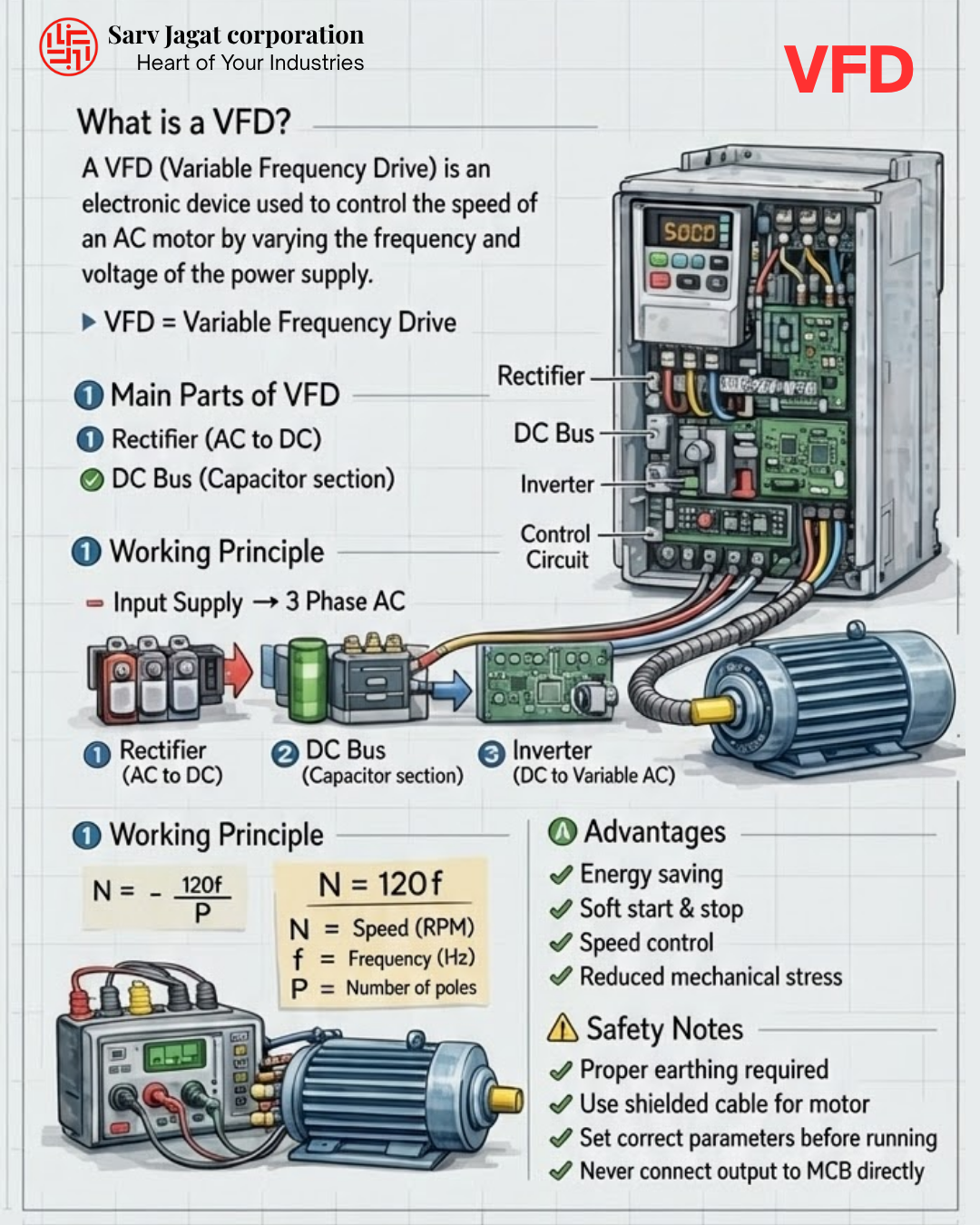
A variable frequency drive is an electronic motor controller that regulates the speed of an AC motor by changing the frequency of its electrical supply.
Motor speed is directly related to supply frequency and the number of motor poles. By controlling the output frequency, a VFD can adjust motor speed to suit the application.
In industrial compressed air systems, VFD technology can help match compressor output with changing air demand.
How Does a VFD Work?
A typical VFD operates through four main stages:
1. AC Input Supply: The drive receives electrical power from an AC supply.
2. Rectifier: The rectifier converts incoming AC power into DC power.
3. DC Bus: Capacitors and associated components stabilize and filter the DC voltage.
4. Inverter: Power electronic switches convert DC power into variable-frequency AC output to control the motor.
By adjusting the output frequency and voltage according to the drive's control strategy, the VFD regulates motor speed.
Key Advantages of VFD Technology
VFDs offer several benefits when correctly selected and configured for the application:
• Energy Efficiency: Potentially reduces energy consumption in variable-load applications by matching motor speed to actual demand.
• Smooth Starting and Stopping: Controlled acceleration and deceleration can reduce starting current and mechanical shock compared with direct-on-line starting.
• Precise Speed Control: Allows motor speed to be adjusted according to process requirements.
• Reduced Mechanical Stress: Controlled starting and speed changes can reduce stress on connected machinery.
• Process Control: Helps maintain suitable operating conditions in applications requiring variable motor speed.
• Operational Flexibility: Supports changing production requirements through adjustable motor control.
Actual energy savings depend on the application, load profile, motor characteristics, drive settings, and overall system design.
Where Are VFDs Used in Industries?
Variable Frequency Drives are commonly used in:
• Industrial screw air compressors
• Water pumps and booster systems
• Industrial ventilation fans
• Conveyor systems
• Manufacturing machinery
• Packaging and processing equipment
• HVAC systems
• Industrial automation systems
In VFD screw compressors, motor speed can be adjusted according to compressed air demand within the compressor's designed operating range. This can help reduce unnecessary unloading operations and improve energy management when demand fluctuates.
Important VFD Installation and Safety Considerations
Correct installation and configuration are essential for safe and reliable VFD operation.
Important precautions include:
• Proper Earthing: Follow the manufacturer's grounding and earthing requirements.
• Suitable Motor Cables: Use correctly rated cables and shielded motor cables where required by the drive manufacturer and installation design.
• Correct Parameters: Configure motor nameplate data, acceleration and deceleration times, protection settings, and control parameters before operation.
• Output-Side Protection: Never connect VFD output directly to an MCB or switchgear as a substitute for a properly designed motor circuit. Output-side devices must be selected and installed according to the VFD manufacturer's instructions.
• Electrical Isolation: Isolate the power supply and allow the DC bus capacitors to discharge for the specified time before servicing. Verify that the equipment is de-energised.
• Qualified Installation: Installation, commissioning, and maintenance should be carried out by trained electrical personnel.
Always follow the VFD manufacturer's installation manual and applicable electrical safety standards.
VFD Technology in Compressed Air Systems
In industrial compressed air applications, air consumption often changes throughout the production cycle. A fixed-speed compressor generally operates according to its control and loading arrangement, while a VFD/VSD compressor can vary motor speed to respond to changing air demand.
A properly selected variable-speed compressor system can offer:
• Better matching of compressor output with changing air demand
• Improved pressure management
• Potential reduction in energy consumption under variable-load conditions
• Reduced unnecessary running
• Greater flexibility in industrial operations
The compressor must still be selected according to actual CFM requirements, working pressure, duty cycle, and operating conditions.
Industrial VFD Compressor Solutions by Sarv Jagat Corporation
At Sarv Jagat Corporation, we integrate VFD technology into industrial compressed air solutions to support variable air demand, suitable pressure control, and efficient operation.
Our product range includes fixed-speed and VFD/VSD rotary screw air compressors, reciprocating piston compressors, refrigerated air dryers, compressed air filters, moisture separators, activated carbon filters, and air receiver tanks.
We focus on selecting suitable compressor technology and air treatment equipment according to each industry's actual operating requirements.
VFD technology is more than motor speed control. When properly engineered, it becomes an important part of industrial energy management and process control.
Sarv Jagat Corporation—Engineering Compressed Air Solutions for Modern Industry.
Contact Sarv Jagat Corporation.
Ahmedabad, Gujarat, India
+91 9157487233 | +91 9157770753
www.sarvjagat.com