
Sarv Jagat Corporation | Piston vs Screw vs Oil-Free Compressors
Piston, screw, or oil-free air compressor—which one is right for your industry? Understand the differences in operating cycles, maintenance, noise, energy efficiency, and compressed air quality to select the right compressor for your application.
| Read Time | 11 min read |
| Status | published |
| Tags | Sarv Jagat Corporation, Piston Air Compressor, Screw Air Compressor, Oil Free Air Compressor, Piston vs Screw Compressor, Screw vs Oil Free Compressor, Industrial Air Compressor Comparison, Air Compressor Selection Guide, Reciprocating Compressor, Rotary Screw Compressor, Fixed Speed Compressor, VFD Air Compressor, VSD Air Compressor, Continuous Duty Compressor, Oil Free Compressed Air, Industrial Compressor Applications, Compressor Duty Cycle, Compressed Air Quality, Compressor Energy Efficiency, Air Compressor Maintenance, Industrial Air Treatment, Refrigerated Air Dryer, Compressed Air Filters, Moisture Separator, Air Receiver Tank, Industrial Compressed Air Solutions |
Project Gallery & MediaSupplied Machinery & Installations
Article Overview & Specifications
Piston vs Screw vs Oil-Free Air Compressor—Which One Is Right for Your Industry?
Let's simplify industrial air compressors in the most practical way possible!
Every compressor type has its own working style, advantages, and ideal applications. Choosing the wrong compressor for your production requirements can lead to unnecessary energy consumption, higher maintenance costs, pressure fluctuations, and operational challenges.
Understanding the difference between a piston compressor, screw compressor, and oil-free compressor is the first step towards building an efficient compressed air system.
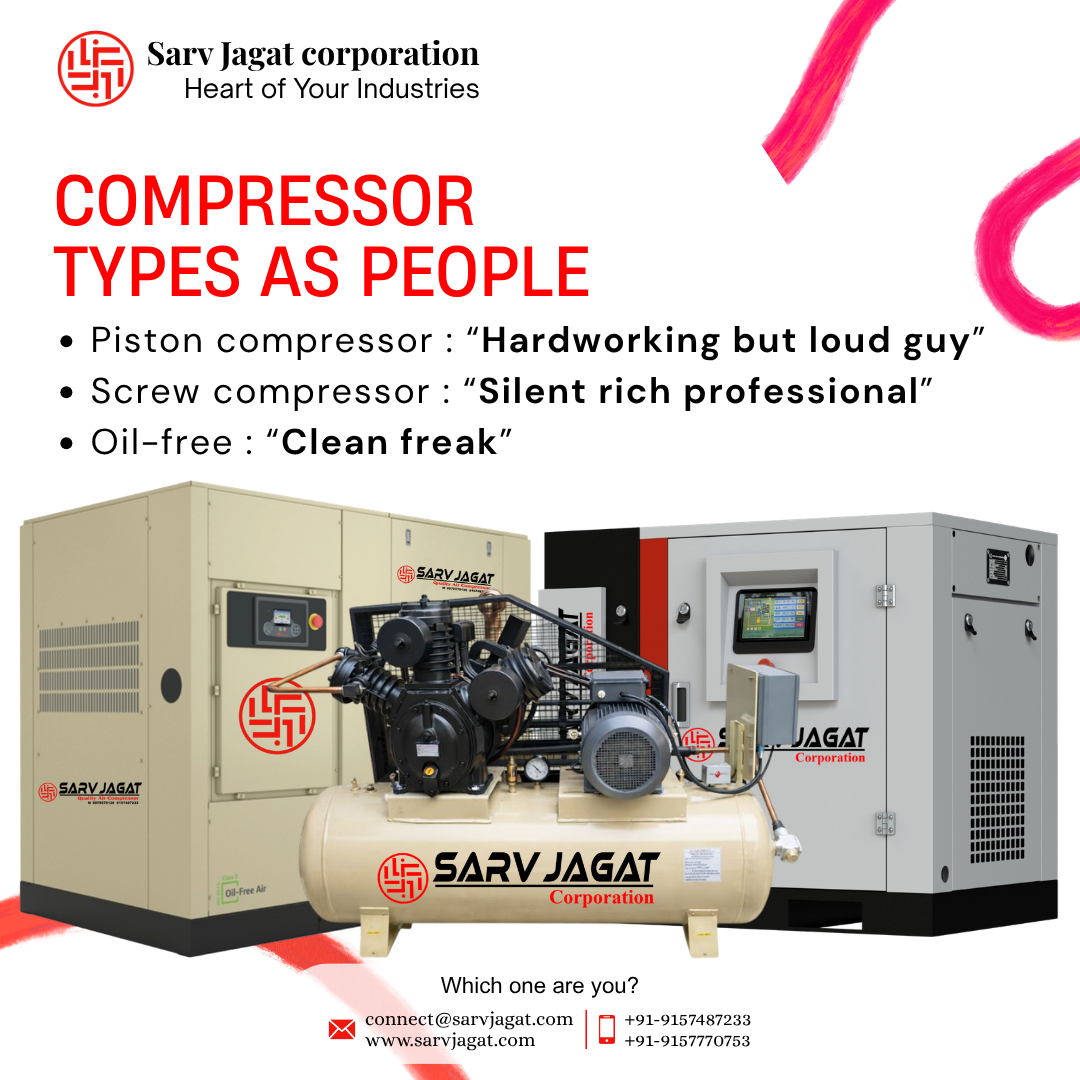
1. Piston Air Compressor—The Hardworking Traditional Performer
A piston compressor is a practical and rugged solution for applications that require compressed air intermittently or at comparatively lower capacities.
Its personality: Hardworking, straightforward, and dependable.
• Uses a reciprocating piston mechanism to compress air.
• Suitable for workshops, garages, small manufacturing units, and intermittent pneumatic applications.
• Available in different capacities and pressure configurations.
• Often has a comparatively lower initial investment.
• Requires periodic maintenance of valves, piston rings, lubrication systems, and other components.
• Can produce higher noise and vibration than many rotary screw models.
Best suited for: Workshops, service stations, small production units, and applications with intermittent air demand.
Some piston compressors are also designed for demanding duty cycles. Always check the manufacturer's rated operating conditions before selecting one for continuous operation.
2. Screw Air Compressor—The Continuous Production Professional
A rotary screw compressor uses two rotating screw elements to compress air and is widely used in industrial applications requiring a steady compressed air supply.
Its personality: Smooth, professional, and production-focused.
• Designed for applications requiring a sustained compressed air supply.
• Provides consistent airflow when correctly sized for the demand.
• Generally operates with lower pulsation and often lower noise than comparable reciprocating systems.
• Suitable for manufacturing plants, fabrication units, food processing, textile industries, and industrial automation.
• Available in fixed-speed and VFD/VSD configurations.
• Requires scheduled servicing, including attention to oil, filters, coolers, and other components in oil-injected models.
Best suited for: Manufacturing facilities, continuous production lines, fabrication, textile processing, and industries with regular compressed air demand.
VFD/VSD advantage: Variable-speed technology can help reduce energy consumption when air demand fluctuates, depending on the plant's load profile and system design.
3. Oil-Free Air Compressor – The Air Purity Specialist
Oil-free compressors are designed to avoid introducing lubricating oil into the compression chamber, making them suitable for applications with strict compressed air purity requirements.
Its personality: Clean, precise, and quality-conscious.
• Designed for applications requiring oil-free compressed air.
• Suitable for selected pharmaceutical, food processing, electronics, medical, and specialized manufacturing applications.
• Helps avoid contamination from compressor lubricating oil in the compression process.
• Requires application-specific air quality assessment and suitable downstream treatment.
• May involve a higher initial investment depending on technology and capacity.
Best suited for: Applications where oil contamination must be controlled according to the required compressed air quality standards.
An oil-free compressor alone does not guarantee complete compressed air purity. Moisture, particles, and microbiological contamination may also need to be controlled through suitable filtration, drying, system design, and testing.
The Reality: Choosing the Wrong Compressor Can Increase Operating Costs
Many industries do not necessarily choose the wrong machine. They select equipment without fully understanding their actual application requirements.
This can lead to several operational problems:
• Energy Waste: Incorrect compressor sizing or unsuitable control technology can increase electricity consumption.
• Pressure Drops: Poor pipeline design, undersized accessories, and clogged filters can affect pressure at the point of use.
• Frequent Maintenance: Operating equipment outside its recommended conditions can increase component wear.
• Product Quality Issues: Inadequate compressed air treatment can affect processes that require controlled air quality.
How to Select the Right Industrial Air Compressor
The right compressor is not selected by horsepower or purchase price alone. A proper selection considers four essential factors:
1. Application: Understand which machines and processes will use compressed air.
2. Duty Cycle: Determine whether the requirement is intermittent, variable, or continuous.
3. Air Quality: Identify the required oil, moisture, and particle control for the application.
4. System Design: Evaluate CFM demand, operating pressure in bar, pipeline sizing, air receiver capacity, dryers, filters, and future production requirements.
Complete Compressed Air Solutions by Sarv Jagat Corporation
At Sarv Jagat Corporation, we help industries understand their compressed air requirements and select suitable compressor solutions.
Our product range includes:
• Reciprocating piston air compressors
• Rotary screw air compressors
• Fixed-speed and VFD/VSD compressor systems
• Oil-free compressor solutions
• High-pressure compressor systems
• Refrigerated air dryers
• Pre-filters, after-filters, and fine and micro-filters
• Activated carbon filters and moisture separators
• Air receiver tanks and supporting accessories
Our focus is not simply on supplying a machine. It is on helping industries choose a compressed air system that matches their actual operating requirements.
Because in industry, the wrong compressor choice can become a long-term operating cost. The right choice starts with understanding your application.
Contact Sarv Jagat Corporation.
📞 +91 9157487233 | +91 9157770753
📧 connect@sarvjagat.com
🌐 www.sarvjagat.com
📍 Ahmedabad, Gujarat, India