
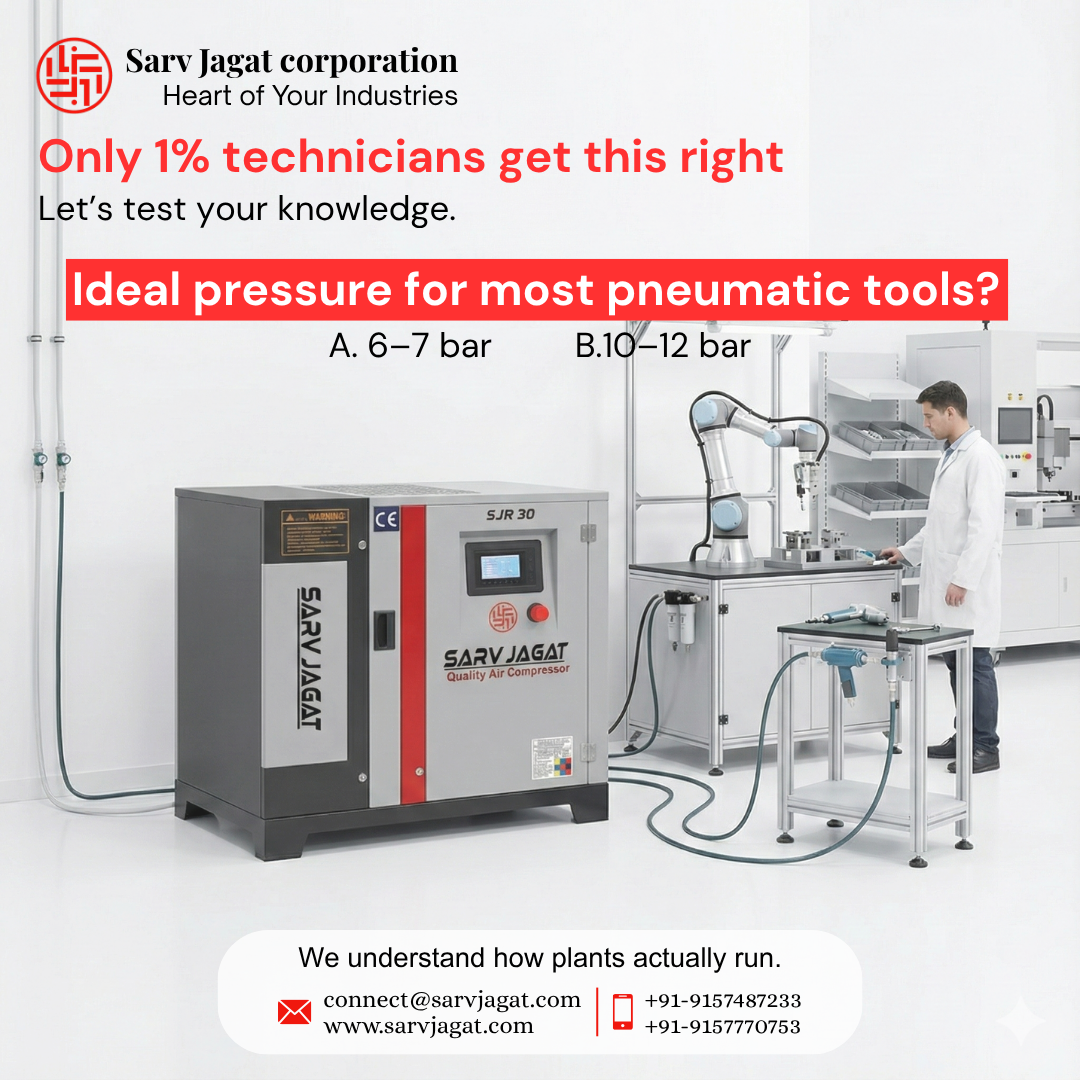
Sarv Jagat Corporation | Ideal Air Pressure for Pneumatic Tools: 6–7 Bar
Most pneumatic tools are designed to operate within a specified pressure range, commonly around 6–7 bar for many industrial applications. Learn how correct air pressure, adequate CFM, proper compressor sizing, and efficient pipeline design help improve tool performance, reduce energy waste, and extend equipment life.
| Read Time | 2 min read |
| Status | published |
| Tags | Sarv Jagat Corporation, Ideal Air Pressure for Pneumatic Tools, Pneumatic Tool Operating Pressure, 6–7 Bar Air Pressure, Industrial Air Compressor, Compressed Air System, Pneumatic Tools, Compressed Air CFM, Air Compressor Pressure Settings, Industrial Air Pressure, Compressed Air Efficiency, Air Compressor Sizing, Compressed Air Pipeline Design, Pressure Drop in Air Lines, Pneumatic Equipment, Industrial Air Consumption, Air Compressor Energy Efficiency, Compressed Air Distribution System, Industrial Pneumatic Systems, Air Compressor Solutions, Ahmedabad Gujarat |
Project Gallery & MediaSupplied Machinery & Installations
Article Overview & Specifications
Only 1% of technicians get this right.
Most people either overestimate the required air pressure or assume that more pressure automatically means better performance.
Wrong.
Question: What is the ideal operating pressure for many pneumatic tools?
A. 6–7 bar
B. 10–12 bar
Correct Answer: A —6–7 bar ✅
Many common pneumatic tools are designed to operate around 6–7 bar. However, the correct operating pressure depends on the specific tool, manufacturer recommendations, and application requirements. Always check the tool's rated pressure before adjusting your compressed air system.
What Happens If You Use Higher Pressure Than Required?
Operating pneumatic tools at 10–12 bar when they are designed for a lower pressure does not automatically improve performance. Excessive pressure can cause several problems:
• Faster tool wear
• Damage to seals and internal components
• Higher compressed air consumption
• Increased energy costs
• Reduced equipment service life
Using more pressure than necessary can increase operating costs without delivering a corresponding improvement in productivity.
Reality Check: Pressure Is Not the Same as Performance
Pressure + Adequate CFM + Stable Air Delivery = Reliable Tool Performance
Pressure alone does not determine how well a pneumatic tool performs. The system must also supply sufficient airflow, measured in CFM, at the required operating pressure.
If a pneumatic tool needs unusually high pressure to perform properly, investigate the underlying cause before increasing the compressor's pressure setting.
Possible causes include:
→ Pressure drop across pipelines, fittings, or filters
→ Incorrect compressor sizing or insufficient airflow
→ Undersized compressed air piping
→ Air leaks or restrictions in the distribution system
→ Inadequate air delivery during peak demand
How Can Industries Improve Compressed Air Efficiency?
✔ Set operating pressure according to the tool manufacturer's specifications.
✔ Select an industrial air compressor with suitable airflow capacity and operating pressure.
✔ Design compressed air pipelines to minimize unnecessary pressure losses.
✔ Inspect filters, fittings, hoses, and connections for restrictions and leaks.
✔ Measure pressure at the point of use to identify distribution problems.
✔ Avoid increasing system pressure without identifying the actual cause of poor performance.
At Sarv Jagat Corporation, we focus on delivering the right pressure at the right airflow for industrial applications. Our compressed air solutions are designed around application requirements, helping businesses evaluate compressor capacity, operating pressure, and air distribution for reliable system performance.
Because efficient systems don't simply run harder—they run smarter.
📍 Ahmedabad, Gujarat, India
📞 +91 9157487233 | +91 9157770753