
Sarv Jagat Corporation | How to Calculate Actual Air Compressor CFM
Rated CFM does not always represent the actual compressed air output available in your plant. Learn how to estimate real air compressor CFM using an air receiver tank volume, pressure difference, and filling time. Understanding actual compressor airflow helps industries evaluate performance, identify system inefficiencies, and make better compressed air system sizing decisions.
| Read Time | 3 min read |
| Status | published |
| Tags | Sarv Jagat Corporation, Actual Air Compressor CFM, Air Compressor CFM Calculation, How to Calculate CFM, Real CFM Measurement, Compressor Airflow Measurement, Rated CFM vs Actual CFM, Free Air Delivery, FAD Calculation, Air Receiver Tank Test, Compressor Performance Testing, Industrial Air Compressor, Air Compressor Capacity, Compressed Air Flow Rate, Air Compressor Testing, 500 Litre Air Receiver Tank, Industrial Compressed Air System, Compressor Efficiency, Compressed Air System Optimization, Air Compressor Sizing, Industrial Airflow Requirements, Ahmedabad Gujarat |
Project Gallery & MediaSupplied Machinery & Installations
Article Overview & Specifications
Check the REAL CFM of Your Air Compressor—Not Just the Nameplate Value.
In industrial environments, compressor performance problems do not always come from machine failure. Sometimes, they come from incorrect assumptions about actual airflow capacity.
Many industries rely only on the rated CFM mentioned on an air compressor nameplate or datasheet. However, the actual air delivery available under plant operating conditions can differ due to operating pressure, temperature, system losses, air leakage, and changing air demand.
Understanding the difference between rated airflow and measured compressor output is essential for maintaining an efficient compressed air system.
How to Calculate Actual Air Compressor CFM
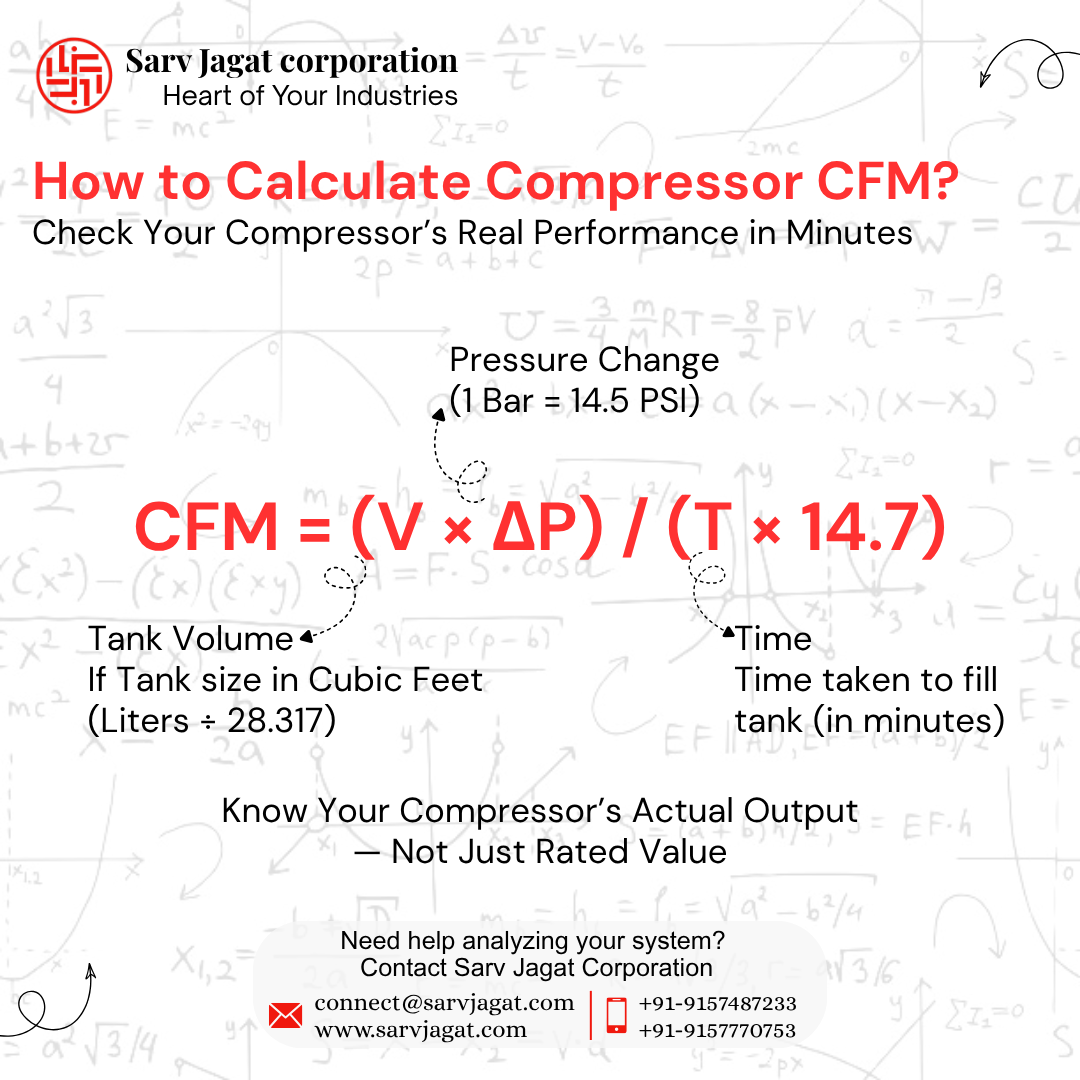
A simplified air receiver filling method can be used to estimate compressor airflow.
Formula:
CFM = (V × ΔP) ÷ (T × 14.7)
Where:
• V = Air receiver tank volume in cubic feet (ft³)
• ΔP = Pressure increase in PSI
• T = Time taken in minutes
• 14.7 = Approximate atmospheric pressure at sea level in PSI
Example Calculation
Consider the following air compressor testing values:
• Tank volume: 500 liters = 17.66 ft³
• Pressure increase: 16 bar = 232.06 PSI
• Filling time: 4 minutes 20 seconds = 4.33 minutes
Calculation:
CFM = (17.66 × 232.06) ÷ (4.33 × 14.7)
Estimated Airflow = 64.38 CFM
This result assumes the receiver pressure rises from 0 to 16 bar gauge during the test, with no air consumption or leakage.
For an accurate field measurement, record both initial and final tank pressures. The pressure difference must be used in the calculation.
Temperature changes, leakage, air consumption during testing, and other test conditions can also affect the result.
What Does Actual CFM Tell You?
If your production equipment requires more airflow than your compressor can deliver, the system may struggle to maintain the required operating pressure.
This can lead to:
• Pressure fluctuations
• Reduced machine efficiency
• Higher energy consumption
• Increased compressor operating load
• Unexpected production downtime
Reality Check: Rated CFM vs Actual Airflow
Rated CFM, or Free Air Delivery (FAD), is determined under specified test conditions and standards. Actual performance in an industrial plant can vary depending on operating pressure, inlet conditions, temperature, maintenance condition, and system configuration.
Your plant has real operating conditions, including heat, air leakage, pressure losses, and variable demand.
If actual compressor airflow is not evaluated, equipment selection and system planning may be based on incorrect assumptions.
Why Is Measuring Actual CFM Important?
✔ Evaluate actual compressor performance.
✔ Identify potential airflow deficiencies.
✔ Check whether compressor capacity matches production demand.
✔ Avoid incorrect compressed air system sizing.
✔ Identify opportunities to reduce energy waste.
✔ Support stable pressure and reliable production operations.
Sarv Jagat Approach
At Sarv Jagat Corporation, we focus on real performance data rather than assumptions. Our approach to industrial compressed air solutions considers actual airflow requirements, operating pressure, compressor capacity, and system design.
From industrial air compressor selection to compressed air system planning and installation, understanding real operating requirements helps businesses build reliable and efficient systems.
In industry, small miscalculations can lead to big operational losses.
📍 Ahmedabad, Gujarat, India
📞 +91 9157487233 | +91 9157770753
🌐 www.sarvjagat.com