
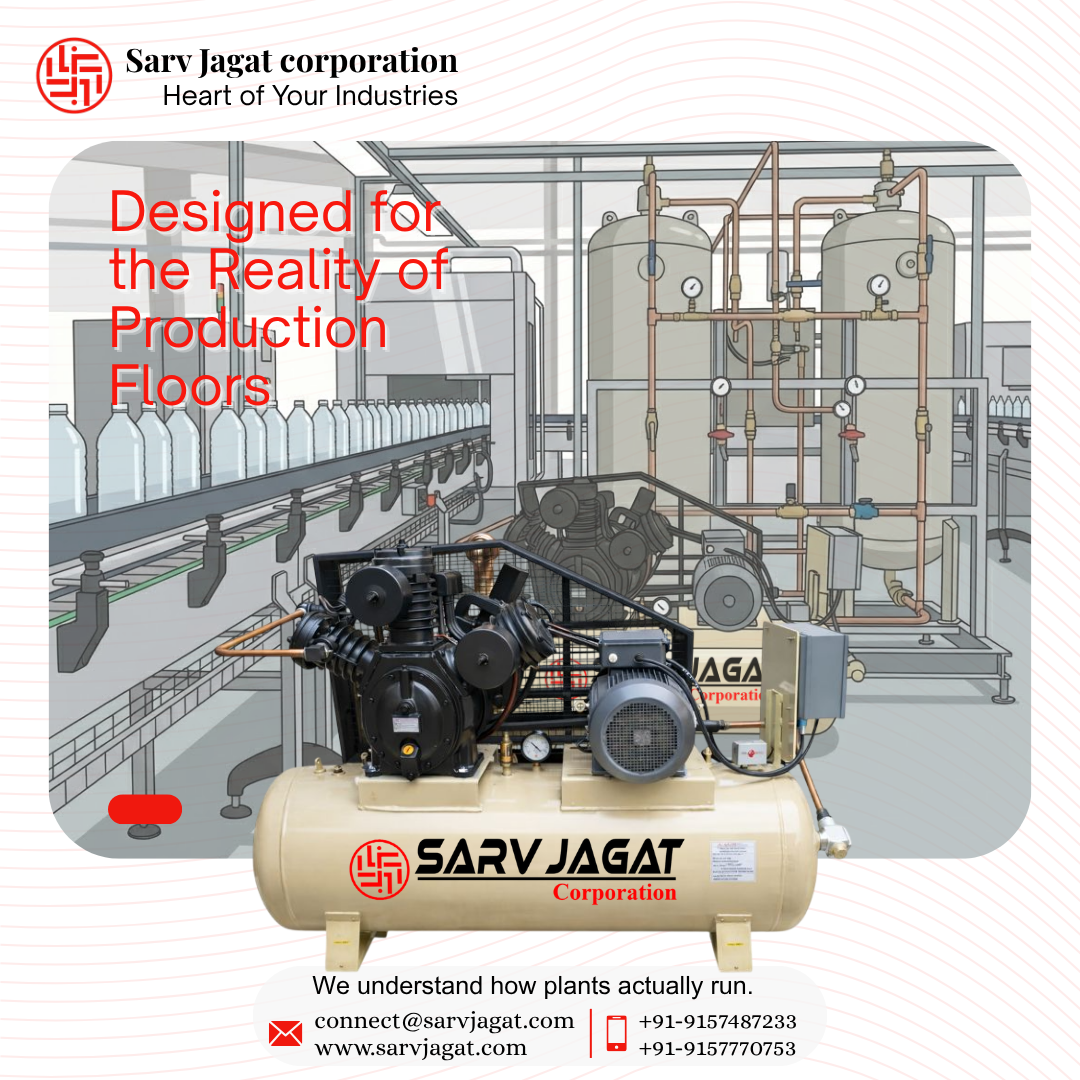
Sarv Jagat Corporation | Compressed Air Systems for Real Plant Conditions
A compressed air system that looks efficient on paper may perform differently on the production floor. Learn how fluctuating air demand, pressure drops, heat, dust, and moisture affect industrial compressor performance and why application-based system design matters.
| Read Time | 10 min read |
| Status | published |
| Tags | Sarv Jagat Corporation, Industrial Compressed Air System, Compressed Air System Design, Industrial Air Compressor, Compressor Engineering, Real Plant Conditions, Industrial Air Demand, Compressor Load Analysis, Air Compressor Sizing, Compressor CFM Requirements, Working Pressure Management, Compressed Air Pressure Drop, Industrial Pipeline Design, VFD Screw Air Compressor, VSD Compressor System, Fixed Speed Air Compressor, Refrigerated Air Dryer, Compressed Air Filtration, Moisture Separator, Industrial Air Receiver Tank, Energy Efficient Compressed Air System, Industrial Production Efficiency, Ahmedabad Gujarat |
Project Gallery & MediaSupplied Machinery & Installations
Article Overview & Specifications
Compressed Air Systems Must Perform on the Production Floor, Not Just on Paper
Most compressed air systems look good on paper. However, their actual performance is tested on the production floor, where operating conditions are constantly changing.
Industrial plants rarely operate under ideal conditions. Multiple machines may run simultaneously, air demand can fluctuate throughout the day, and long pipeline networks can create pressure losses. Heat, dust, and moisture can also influence equipment performance and compressed air quality.
If a compressed air system is not designed around these real operating conditions, the result can be unstable performance, unnecessary energy consumption, and production interruptions.
At Sarv Jagat Corporation, we believe compressed air system design should begin with understanding the actual requirements of the plant.
Why Do Compressed Air Systems Perform Differently in Real Industries?
A compressor's rated specifications provide important information, but selecting equipment based only on its HP, CFM, or maximum pressure does not guarantee that the complete system will meet production requirements.
Real industrial environments involve several operating challenges:
• Fluctuating Air Demand: Different machines consume different amounts of compressed air, and their operating cycles may change throughout the day.
• Multiple Machines Running Simultaneously: Combined air consumption can increase significantly when several production machines operate together.
• Pressure Drops in Pipelines: Long pipelines, undersized piping, fittings, filters, and other restrictions can reduce pressure at the point of use.
• High Operating Temperatures: Ambient heat and inadequate ventilation can affect compressor cooling and operating conditions.
• Dust and Contamination: Industrial environments can introduce contaminants that affect air intake, filtration, and equipment maintenance.
• Moisture in Compressed Air: Compression produces moisture that must be managed through suitable separation, drying, and condensate removal.
These factors must be evaluated before finalizing a compressor and air treatment configuration.
What Happens When a System Is Not Designed for Actual Plant Conditions?
An incorrectly sized or poorly configured compressed air system may experience:
• Pressure instability during peak production
• Higher energy consumption
• Frequent compressor loading and unloading
• Increased maintenance requirements
• Moisture-related problems in pneumatic equipment
• Reduced machine efficiency
• Unexpected production interruptions
The problem may not be the compressor alone. It can also originate from inadequate air treatment, incorrect pipeline sizing, poor distribution, or a mismatch between air supply and actual demand.
What Does Proper Compressed Air System Design Require?
A reliable industrial compressed air system must be planned around the complete production environment.
Important engineering considerations include:
✔ Real Load Conditions: Analyze actual air consumption, operating hours, machine cycles, and variations in demand.
✔ Proper System Sizing: Select compressor capacity according to measured or calculated airflow requirements and the required working pressure.
✔ Pressure Drop Evaluation: Consider pipeline length, diameter, fittings, filters, dryers, and distribution layout.
✔ Stable Pressure Delivery: Configure suitable compressor controls and distribution systems to support the required pressure at the point of use.
✔ Appropriate Air Treatment: Select moisture separators, refrigerated dryers, and filtration equipment according to the required compressed air quality.
✔ Long-Term Reliability: Consider ventilation, cooling, maintenance access, condensate management, and future production expansion.
A well-designed system brings the compressor, air treatment equipment, receiver tank, and distribution network together as one coordinated solution.
Compressed Air System Solutions by Sarv Jagat Corporation
At Sarv Jagat Corporation, we focus on industrial compressed air solutions based on actual application requirements and operating conditions.
Our product range includes:
• Industrial rotary screw air compressors
• Fixed-speed and VFD/VSD compressor systems
• Reciprocating piston air compressors
• Refrigerated air dryers
• Pre-filters, after-filters, and fine and micro-filters
• Activated carbon filters and carbon towers
• Moisture separators
• Industrial air receiver tanks
From compressor capacity and working pressure to air treatment and distribution requirements, every part of the system plays an important role in overall performance.
Industrial Performance Is Proven on the Shop Floor
A compressed air system should not be judged only by its catalogue specifications. Its real value is determined by how effectively it supports machinery, maintains the required operating pressure, manages air quality, and performs under actual production conditions.
At Sarv Jagat Corporation, we design compressed air solutions around real plant requirements—not assumptions.
Industrial performance doesn't depend on theory alone. It depends on how the system performs on the shop floor.
Contact Sarv Jagat Corporation.
📍 Ahmedabad, Gujarat, India
📞 +91 9157487233 | +91 9157770753
🌐 www.sarvjagat.com