
Sarv Jagat Corporation | Brochure CFM vs Actual Air Compressor CFM
Is your air compressor delivering the CFM mentioned in its brochure? Understand how temperature, atmospheric pressure, altitude, humidity, voltage, and operating conditions affect compressor performance and actual air delivery in industrial environments.
| Read Time | 11 min read |
| Status | published |
| Tags | Sarv Jagat Corporation, Compressor CFM, Actual Compressor CFM, Brochure CFM vs Actual CFM, Free Air Delivery, FAD Air Compressor, Air Compressor Capacity, Industrial Air Compressor Performance, Compressor Airflow Measurement, CFM at Operating Pressure, Compressor Inlet Temperature, Ambient Temperature Effect on Compressor, Altitude Effect on Air Compressor, Atmospheric Pressure, Humidity in Compressed Air, Compressor Voltage Requirements, Industrial Compressor Selection, Screw Air Compressor, VFD Screw Compressor, Fixed Speed Compressor, Compressed Air System Design, Air Compressor Efficiency, Industrial Compressed Air Solutions, Ahmedabad Gujarat |
Project Gallery & MediaSupplied Machinery & Installations
Article Overview & Specifications
Brochure CFM vs Actual CFM—What Is Your Air Compressor Really Delivering?
Most industries trust the CFM mentioned in an air compressor brochure. But there is an important question that often gets overlooked:
At what operating conditions is that CFM measured?
Compressed air output is influenced by several operating and environmental conditions. The airflow capacity specified in a compressor brochure may be measured under defined test conditions, but actual performance at an industrial plant can vary depending on installation conditions, inlet air quality, operating pressure, and compressor design.
Ignoring these factors can lead to incorrect compressor selection, insufficient airflow, pressure fluctuations, and unnecessary energy consumption.
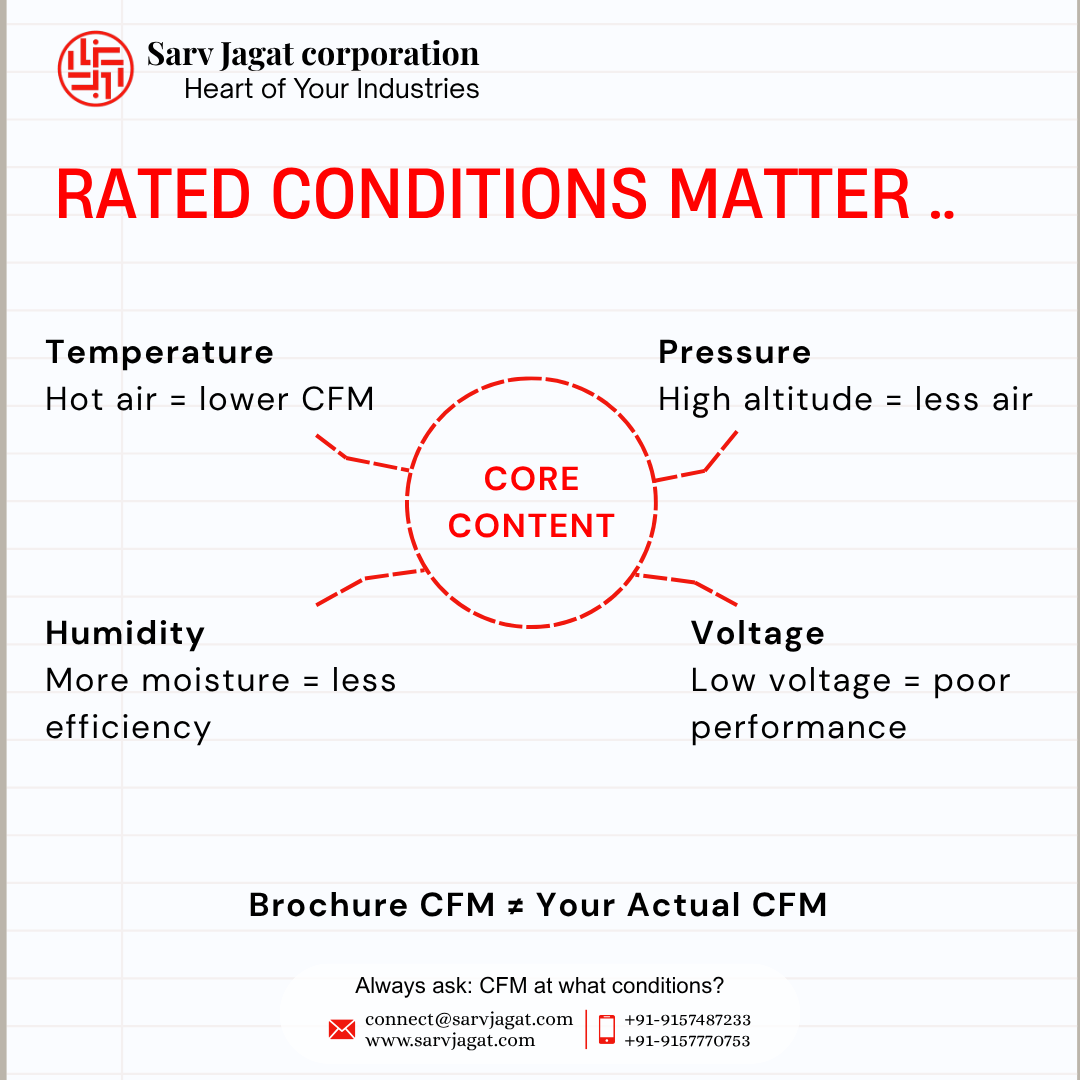
What Factors Affect Actual Compressor CFM?
Understanding these factors helps industries evaluate compressor performance more accurately.
1. Temperature—Hot Air Affects Air Density
Temperature plays an important role in compressor intake conditions.
• Higher inlet air temperature reduces air density.
• Lower air density means less air mass enters the compressor for the same intake volume.
• High ambient temperatures can also affect compressor cooling and operating performance.
Proper ventilation and suitable compressor installation conditions help maintain reliable operation.
2. Atmospheric Pressure and Altitude – Location Matters
Atmospheric pressure decreases as altitude increases. This affects the density of air entering the compressor.
• Higher-altitude locations have lower atmospheric pressure.
• Lower intake air density can reduce compressor mass-flow capacity.
• Compressor performance should be evaluated using the manufacturer's altitude correction data where applicable.
This is particularly important when selecting industrial air compressors for plants located at higher elevations.
3. Humidity—Moisture in Intake Air
Humidity affects the composition and density of atmospheric air.
• Humid air contains more water vapour and less dry-air mass at the same temperature and pressure.
• Moisture can condense inside compressed air systems as air cools.
• Proper moisture separation and air drying help protect downstream equipment and maintain the required compressed air quality.
Humidity should be considered along with temperature and atmospheric pressure when evaluating intake conditions.
4. Voltage and Electrical Supply – Motor Performance Matters
The electrical supply also influences compressor operation.
• Voltage outside the motor's permitted range can affect motor current, heating, and performance.
• Voltage imbalance and poor electrical connections can increase electrical stress.
• An improperly configured electrical supply may cause protective trips or operating problems.
However, low voltage does not automatically result in a predictable reduction in CFM. Actual airflow depends on motor characteristics, compressor loading, control systems, and operating conditions.
Why Brochure CFM and Actual Air Delivery Can Differ
A compressor's advertised CFM must be understood in relation to its measurement standard and specified test conditions.
Different airflow ratings may refer to different measurements, including:
• Displacement CFM: Theoretical air volume displaced by the compressor's compression elements.
• FAD (Free Air Delivery): Actual delivered air expressed as an equivalent volume at specified inlet reference conditions.
• Operating Airflow: Air delivered under the actual operating pressure and installation conditions.
These values are not interchangeable.
When comparing industrial air compressors, always check the specified FAD, operating pressure, test standard, inlet conditions, and manufacturer's performance data.
What Happens When Actual Airflow Is Lower Than Required?
If a compressor cannot meet the plant's actual air demand, several operational problems may occur:
• Pressure Drops: Insufficient airflow can cause pressure to fall when multiple machines operate simultaneously.
• Machine Inefficiency: Pneumatic equipment may not receive the airflow required for proper operation.
• Energy Waste: Poor compressor selection and system design can increase operating costs.
• Production Instability: Inconsistent compressed air supply can affect machine cycles and production output.
-*Increased Equipment Stress: Continuous operation beyond the intended capacity can place additional demands on the compressor system.
What Should You Ask Before Selecting an Air Compressor?
Instead of asking only, "How much CFM does this compressor deliver?" ask:
"What is the actual free air delivery at my required operating pressure and under which reference conditions?"
Before selecting a compressor, evaluate:
• Required airflow in CFM
• Operating pressure in bar
• Manufacturer-specified FAD and test conditions
• Ambient and inlet air temperature
• Site altitude and atmospheric pressure
• Electrical supply conditions
• Operating hours and duty cycle
• Future production requirements
These details help ensure that the selected compressor matches the actual compressed air demand of the plant.
Real-Condition Compressor Selection by Sarv Jagat Corporation
At Sarv Jagat Corporation, we focus on understanding real industrial operating conditions rather than relying only on brochure specifications.
Our compressed air solutions include rotary screw compressors, fixed-speed compressors, VFD/VSD systems, reciprocating piston compressors, refrigerated air dryers, compressed air filters, moisture separators, and air receiver tanks.
We consider airflow requirements, working pressure, operating conditions, air treatment, and complete system design to help industries select suitable compressed air solutions.
Because brochure CFM is only a starting point. Real performance depends on the conditions in which your compressor operates.
Contact Sarv Jagat Corporation.
📍 Ahmedabad, Gujarat, India
📞 +91 9157487233 | +91 9157770753
📧 connect@sarvjagat.com
🌐 www.sarvjagat.com