
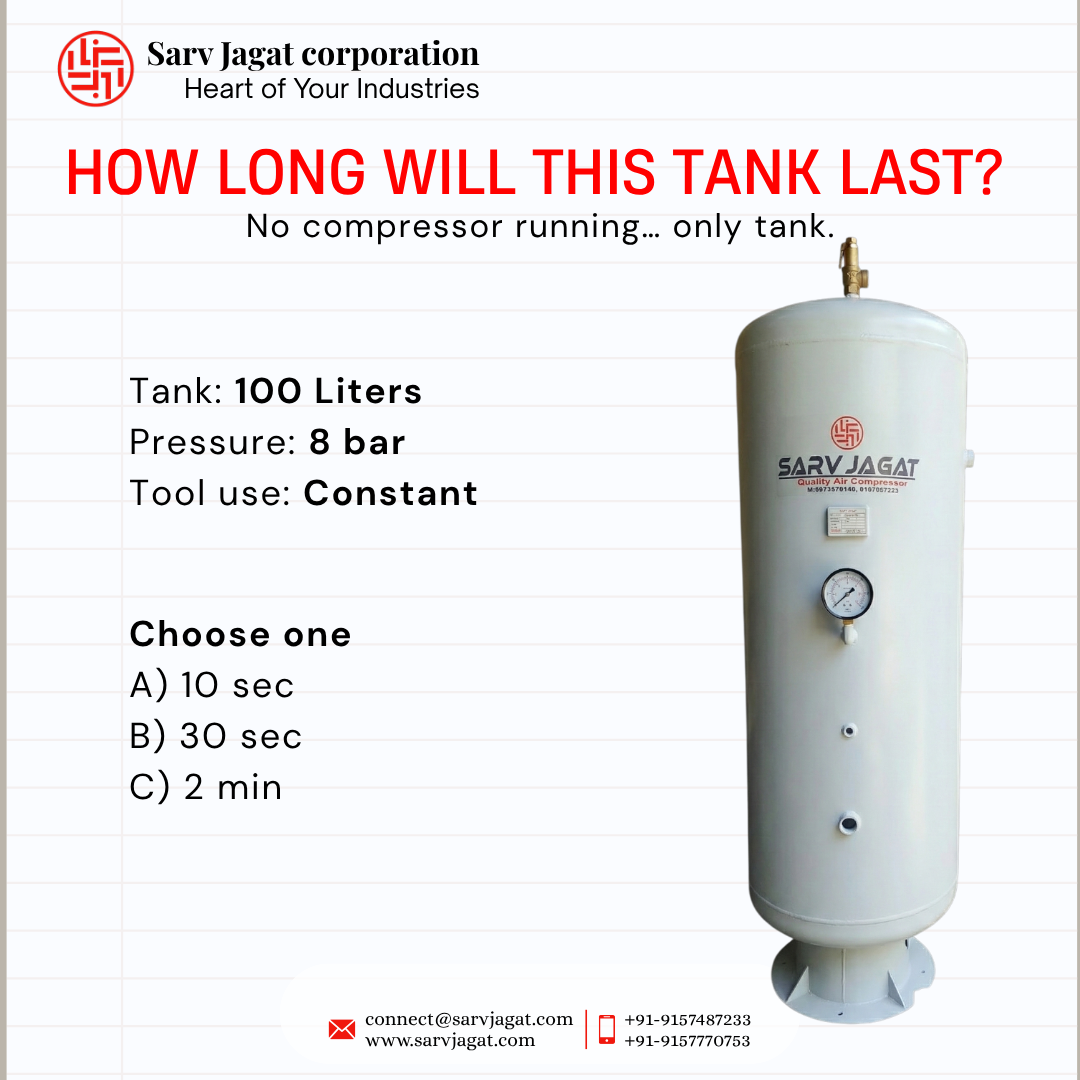
100-Litre Air Receiver Tank at 8 Bar | Backup Time Explained
How long can a 100-litre compressed air receiver tank supply air at 8 bar without a running compressor? The answer depends on the starting pressure, minimum usable pressure, and air consumption. Learn why an air receiver tank acts as a buffer rather than a replacement for compressor capacity.
| Read Time | 2 min read |
| Status | published |
| Tags | 100 Litre Air Receiver Tank, 100L Air Tank, 8 Bar Air Receiver Tank, Compressed Air Storage, Air Receiver Tank Capacity, Air Compressor Backup Time, Compressed Air Consumption, Industrial Air Compressor, Compressor CFM Sizing, Compressed Air Demand, Compressor Supply Capacity, Industrial Compressed Air System, Pressure Drop, Air Receiver Tank Sizing, Pneumatic Tools, Compressed Air Efficiency, Industrial Air System Design, Sarv Jagat Corporation, Ahmedabad Gujarat |
Project Gallery & MediaSupplied Machinery & Installations
Article Overview & Specifications
Most people overestimate air receiver tank backup time, and that is where mistakes begin.
A 100-litre compressed air receiver tank operating at 8 bar cannot provide a fixed backup time without knowing the air consumption and the minimum pressure required by the equipment.
In some operating conditions, the usable air supply may last only around 30 seconds. However, the actual duration depends on the system's starting pressure, the minimum usable pressure, and the connected tools' air consumption.
Why does this happen?
An air receiver tank stores compressed air, providing a buffer that helps manage short-term variations in demand. However, its usable air supply is limited.
What happens when the compressor stops?
• A 100-liter receiver tank has a limited storage capacity.
• At 8 bar gauge pressure, the tank contains more air than it would at atmospheric pressure, but only part of that air may be usable before pressure falls below the equipment's operating requirement.
• Continuous pneumatic tool consumption causes the tank pressure to drop.
• Without the compressor running, the air supply is not replenished.
The result? Depending on air demand and the minimum operating pressure, the available supply may last only seconds.
Common misconception: A bigger air receiver tank means longer backup time.
The reality is that an air receiver tank helps stabilize pressure, accommodate short-term demand peaks, and reduce frequent compressor cycling in suitable systems. It does not replace the compressor's ability to deliver the required airflow continuously.
What should industries focus on?
• Correct compressor sizing based on airflow requirements in CFM.
• Matching compressed air demand with compressor supply capacity.
• Selecting an appropriate air receiver tank based on system requirements.
• Maintaining suitable operating pressure and minimizing pressure drops.
• Evaluating air consumption during peak-demand conditions.
The bottom line: An air receiver tank is a buffer, not a substitute for sufficient compressor capacity.
If production stops shortly after the compressor shuts down, the system may simply lack enough usable stored air to support the connected equipment.
The right solution depends on actual demand, required pressure, and operating conditions.
At Sarv Jagat Corporation, we design industrial compressed air systems around real operating requirements, including compressor capacity, air receiver tank sizing, pressure requirements, and air consumption.
📞 +91 9157487233 | +91 9157770753
📧 connect@sarvjagat.com
🌐 www.sarvjagat.com
📍 Ahmedabad, Gujarat, India